Milkweed

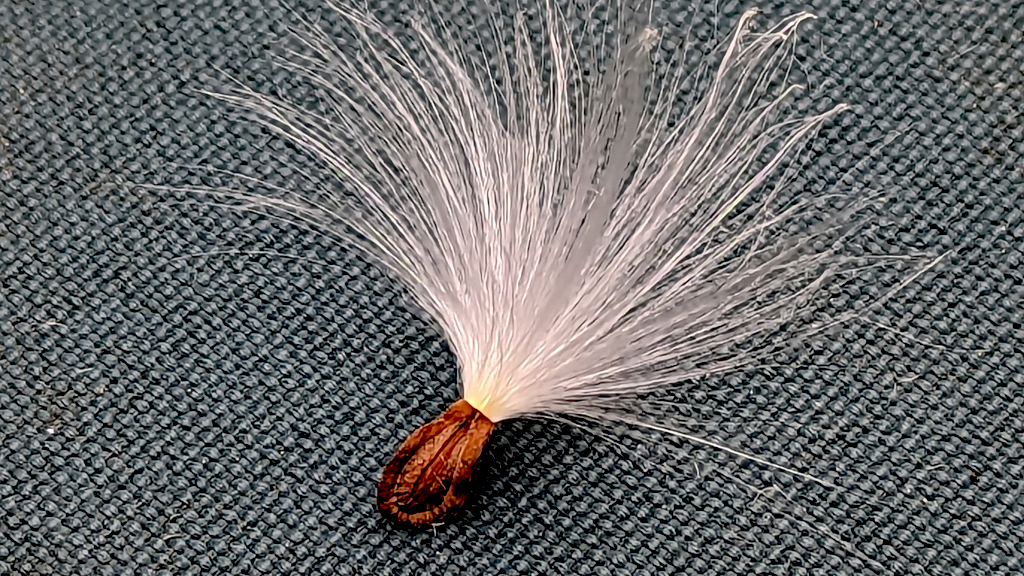
They all went different ways after high school. There was nothing unusual about it, the door was opened and out they went. That's the move, the future, for which they'd all been brought up. She went east to New York City. He went south to the Mid-Atlantic. They were friends, with a touch of competitive ambition, trading places on the various school totems, science fairs, and such. She was one of the group of friends he thought of as "The Big Four," which really had no fixed members, wasn't "four," and expanded and contracted, floated about depending on the season, a number most likely picked because it had an integer square root.
He had plans and everything was spread out ahead, uncertain, but there certainly. There could be no looking back. The past was the past and would be even more so every minute. Later on, once deep into his own research, he used to joke that nothing was more boring than yesterday's results.
So he lost track. Where they went, how they were doing. Eventually as years passed, when the occasional thought of searching out old friends would surface, it always seemed an impossible task. Anyway, what would he say? Tomorrow was pressing on.
And that was the mistake.
In its own time, the future of his plans found the way to the end. As it always does. And then, at that point, the future to come was planless. But looking back, there was nothing to see either. He had let the past fade to nothing. A mistake that could never be rectified in a past tense gone.
Her message showed up in his email queue one day, completely out of the blue. He almost missed it in among the routine endless pleadings of e-commerce sameness. The message began by apologizing in case he wasn't him, and he thought there was a chance that perhaps he might not be him. She had managed to round up another five of the old high school group and they had now chased him down through the internet labyrinth.
I thumb-typed her address into Google Maps. It did it's little screen dance to show how technically difficult the assignment was, and how clever and sophisticated it was, and finally it threw a dart into the map at the magic location in New Hampshire. Not finished, it drew several interconnected lines from us to there, from which I was supposed to choose our favorite. It is always good policy, I presume, to trick the user into a believing they have agency.
We were on our way home from a week-long stay in the north woods of Maine, gazing at the stars under clear skies found nowhere else in the East, marveling at the Milky Way. I was looking forward to seeing her again after all the decades, and we stopped in Camden for something to share. Sue picked out a blueberry pie, while I grabbed a bottle of wine. And we were off, successfully confusing the Google Map avatar as it raced around the screen leading us down its virtual I95.
Google Maps is a marvelous example of algorithmic dedication to task and unswerving devotion to dominance. In practice, Maps can't distinguish a detour to fill up the gas tank from a bout of temporary dementia, the diversion for a blueberry pie from an underworld kidnapping, the call of Nature from the Sirens song. Inevitably, such unscheduled alterations alarm the Google Maps Lady, who senses imminent danger and instantaneously issues directions for a U-turn. There follows a relentless stream of instructions designed to coax the wayward vehicle back: "Proceed to route." She implies there is no time to lose, and that at any minute a great calamity will strike, cloaking past travels in darkness and forever blocking any chance of reaching your destination.
"In 300 feet turn left at River Styx Road. Then bear right on Redemption Blvd. There is a three century delay due to traffic. You are still on the fastest route."
I confess, sometimes I go off track just to provoke her.
We knew we were getting close as the road dropped down to run alongside the Oyster River. A few zigs and zags more and the Google Maps Lady announced, "Your destination is on the left," and she popped up her tip jar to gain a quantitative measure of our gratitude.
A long lane led down through the woods, opening up onto a beautiful meadow of grasses and wild flowers. There was a garden further down, off to the left, and the overall estate was guarded by an articulated grand being of solar panels, who commanded the very motion of the Sun, which dutifully kept its aim and angle across the sky.
The house, nestled in a grove of hardwoods, was a modern example of exactly what you might think a New England home should be. It was founded on an elevated flat of land continuing on down from the meadow, which dropped off gently to be surrounded on three sides by tidal marsh flats thick with fall cattails. The Oyster River drifted by in the middle distance.
"Oh, you've got to see the meadow," she said.
We were together out in the garden. It was well-tended, laid out in a mix of beds and possibilities. The perimeter was fortified with an electric fence, the bite of which was such that it could be turned off once the experience made the rounds of the local miscreants. But best left on, against the occasional naive nomad looking for easy pickings.
Within the perimeter she had planted dwarf peach and apple trees, now old enough to bear. The clever peach trees had taught their fruit to deposit seeds in the mulch and compost, the better to secretly take over the world when spread on the beds. Several volunteers had advanced to the front lines, and discovered the realm was ruled by a soft-hearted gardener who would tend to their every need.
The meadow was rarely mowed, to encourage a native habitat for birds, insects, and butterflies. There in mid-autumn it was a gorgeous span of grasses and late wildflowers. The surrounding woods framing it all with seasonal color.
"Look! Milkweed!"
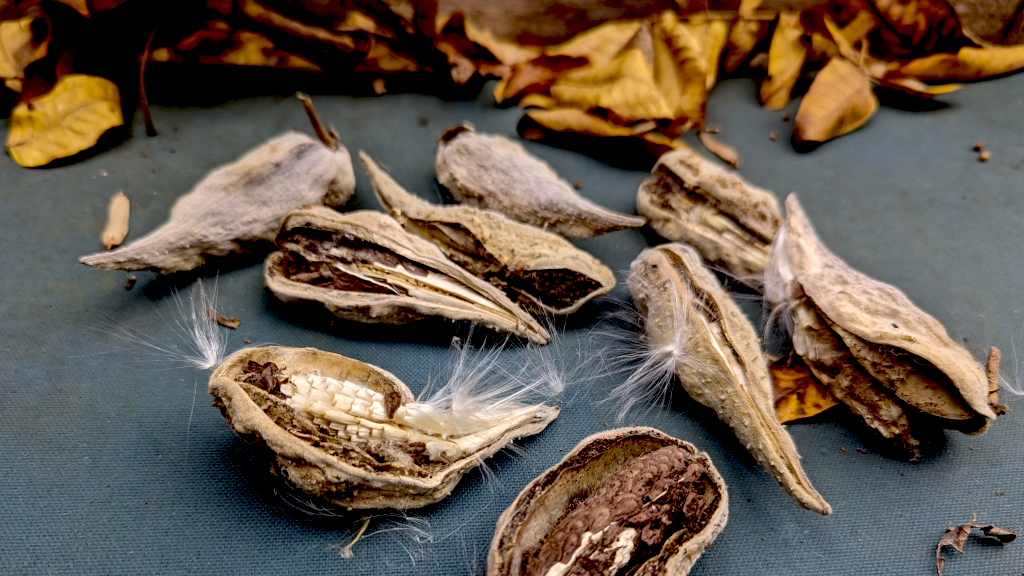
The milkweed stand was a bit off the drive, toward the all-powerful solar deity. Tended, protected from the scythe, it provided beauty, nectar for bees and butterflies, and food for monarch caterpillars. It's the only thing they eat. The milkweed flowers were a memory now. Instead the corp was standing to attention, laden with knobbly pods full of winged seeds waiting for a breeze to lift them off to a future who knows where.
It had been a long time since I had paid notice to milkweed. They were common on my grandfather's farm, and we used to split the pods to watch the stream of parachutes rise high up in the air and disappear into the hay field. But there weren't any milkweed on our property now, and I hadn't noticed that I missed them until just then, standing there in her meadow.
"I do hope milkweed finds your meadow someday," she said.
Just a year or two after the Oyster River visit, our milkweed made its appearance on stage, out from behind an unknown leg.
The site it chose for its new settlement was disturbed land, part of the woods logged by a former owner. Severely disturbed. There is no polite way to log a woods. The contractor drove massive tractor trailers up onto the site, and a "skidder," a mechanical brontosaurus, belching diesel fumes, lumbered up the draw with any tree worth taking, to dump on top of the piles in trailer beds, next trunk up.
After a month of this activity, the site looked like a deserted war zone. Man versus forest. A ridge off the side of the lane completely denuded, defoliated, pock-marked, tire-treaded, and desolate. And abandon. Literally sawed off from its past.
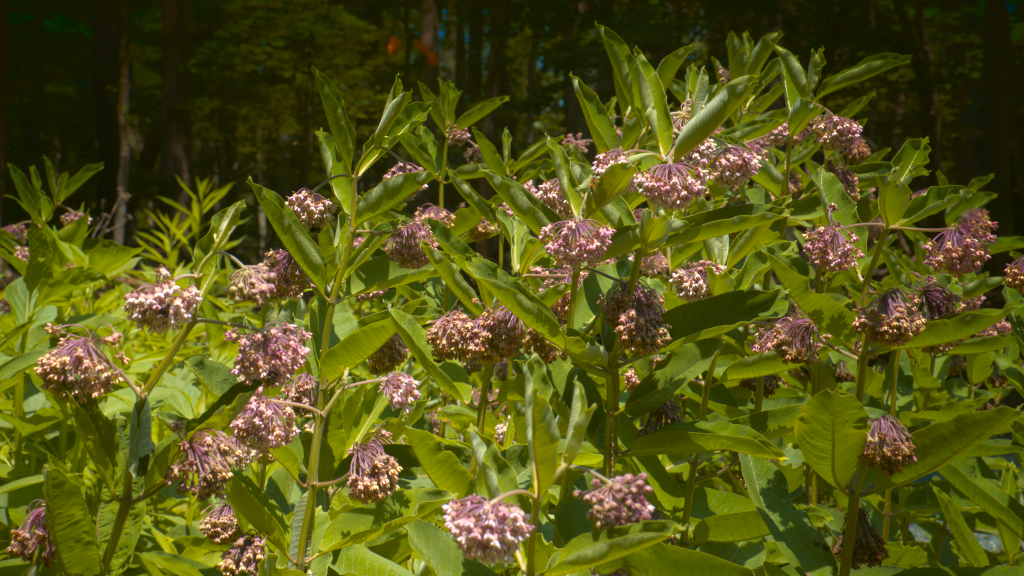
I noticed the flowers first. Early that summer the ridge was covered with these gorgeous purple-pink blooms. I'd never seen them before. What did I know from milkweed. The only things I knew about milkweed, it turns out, were the knobbly pods, like gnome caps, filled with millions of seeds on fluffy white parachutes. This is miracle enough, I submit, but the flowers more than hold their own.
My milkweed ignorance may be the norm.
Looking for enlightenment on milkweedism, I turned first to Taylor's Master Guide to Landscaping, by Rita Buchanan. A big, heavy, glossy tome covering everything horticultural. The inside jacket sleeve proclaims, "Separate chapters explain how to care for landscape plants – trees, shrubs, vines, lawns, ground covers, and perennials." Not a mention of milkweed.
Next I tried Essential Native Trees and Shrubs for the Eastern United States, The Guide to Creating a Sustainable Landscape, by Tony Dove and Ginger Woolridge. A volume just slightly second in terms of weight to the Taylor's. In his preface, Dove writes that their book is meant to provide "a palette of proven 21st-century natives that thrive in varied, diversified landscapes." Not a mention of milkweed. Too old. Pre-21st-century, I guess. Too much of the past.
And so it went. All the index entries I checked just jumped from "mildew" to "mimosa," erasing "milkweed" by omission. Not even a blank void holding place between entries. Which is okay, I suppose, since milkweed seems to manage fine on its own in a former war zone.
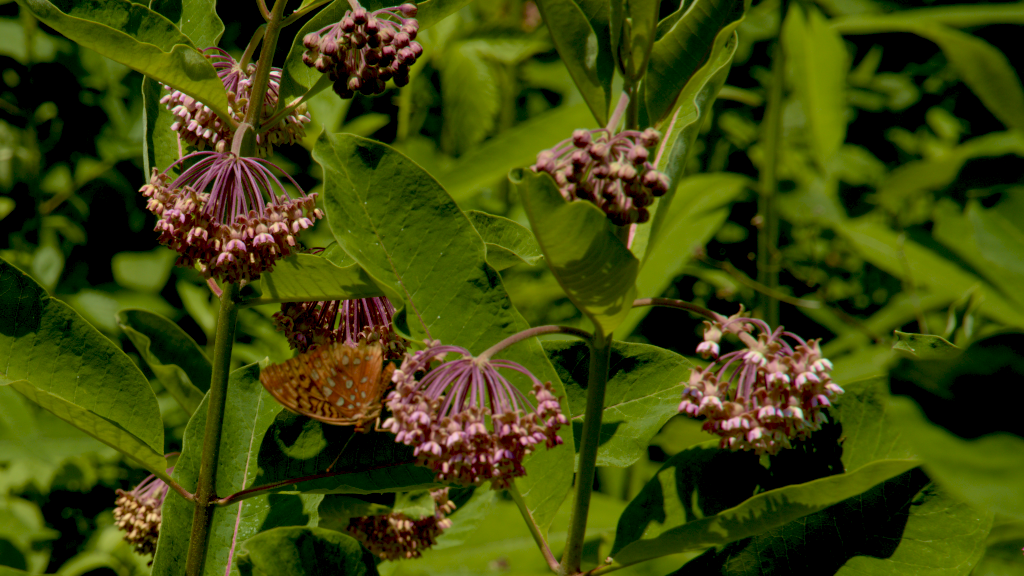
And it brings a vast menagerie of butterflies and insects. Here, at any one time, we have several dozen great spangled fritillary butterflies (Speyeria cybele) in dazzlingly orange display, dancing from flower head to flower head, challenging the hand-eye coordination, and limited focus, of anyone trying to camera-catch them. The slightly fuzzy image below is all the proof you need.
Eastern tiger swallowtail butterflies (Papilio glaucus) also preside over the festivities, giving the scene a bit of class with the imprimatur of the official insect of Virginia.
The butterflies are joined by a dazzling complexity of other insects with whom I have yet to become acquainted, and lastly by the milkweed bugs, elongated red and black insects that feed on common milkweed. You can't miss them. They stand out from the pack like a Jack of Diamonds. There are "large" milkweed bugs (Oncopeltus fasciatus), and "small" milkweed bugs (Lygaeus kalmii), and since the "large" milkweed bug is 11-12 mm long, and the "small" milkweed bug is 10-12 mm long, and since they look identical from a non-intrusive observing distance, I can't tell you the proportions of each feeding at the table.
What is still missing, as far as I know, what we have not had, is monarch butterflies. But there is reason for hope; they are naturally found in our area. The iNaturalist website reports equal numbers of fritillary and monarch butterfly sightings for our county. That's promising. And one of those monarch sightings came from just a little over a mile away in 2023. So there you have it, a plan for the future.
I wish you milkweed.