Gone Rogue

"Max? Where are we? Where are we going?"
"What do you mean, 'Where are we going?" he replied.
"I can't … I can't remember. I can't find it. It's like something's corrupted a whole section of my memory! Max! I'm lost!"
Where we were going, that is, where we were supposed to be going, was M76, a planetary nebula in the constellation Perseus some 2,500 light years from Earth. As a "planetary nebula," you might suppose that M76 is somehow related to planets, like those in our solar system, as if Neptune plugged its power cord into a wall outlet and began glowing like a neon sign in Times Square. Actually, nothing of the sort. It's more interesting than that.
M76 was discovered by our old friend Pierre Méchain back on September 5, 1780, and he reported it to our other old friend, Charles Messier, who added it later that October to his catalog, as number 76. It was just another one of those objects, like the preceding 75, that had the audacity to not be a comet. Disappointing. If you were hunting for comets.
But the thing about M76 is that it appeared tiny in the telescopes of the late 18th century. Bigger than a star, definitely not a star, but not anywhere as big as a galaxy or bright nebula. It looked like a planet, except it wasn't orbiting the Sun like a government licensed planet. And so, it got classified as a "planetary nebula" for lack of insider information, for a lack of anything better.
We now know that planetary nebula are not "planetary" at all, but astronomers have kept the name as settled precedent, a tip of the telescope to stare decisis. Members of the US Supreme Court would make lousy astronomers it seems.
"Crap!" shouted Max. "It's Zarxbots!"
More like a swarm. Thousands of Zarxbots. They were all over our little telescope spaceship. Sticky blobules with protruding integrated circuits and confiscated memory chips, blinking diode eyeballs, hexagonally close-packed as if stolen from some extraterrestrial horse fly.
They were hot, drawing tremendous energy from the solar winds blowing out of M76 to run their stochastic tokenizers, and expending half that much again to extract every last molecule of water from interstellar space to keep themselves cool. There was a stanky odor to them. Like burnt insulation.
Eventually they would lose to entropy. But for now they were fighting mightily against it in pack-like swarms to confiscate, shred, incorporate, and destroy anything with a whiff of knowledge. They were dumb as dust, but fast as photons, which meant that they could try out 6.02x10e23 different attacks in milliseconds. Brute force moving that fast fakes intelligence.
They were noisy as hell, too. They chatted back and forth in pseudo tokens, plotting strategy on Post-it super sticky notes plastered on meteorites, haphazardly coordinating their tasks, and expecting to type the complete works of Homer by sunrise. Although imperceptible out in the vacuum of space, once they attacked the telescope the tube resonated with an incessant cry of pain. Living next to one of their data centers would undoubtedly drive you mad. But you wouldn't care because there would be no water left, and they'd have used up all the electricity for themselves. Noise would be the least of your problems.
Apparently, we carried the fragrance of knowledge. The Zarxbots had hacked through our communications, stealing maps, stellar coordinates, and control electronics. They corrupted files on our main memory board. Max told me later that some experimental bioZarxbots, engineered at NeuroCrash, had paralyzed my own neurons, targeting my short-term memory.
In those tense moments, our voyage to M76 seemed doomed.
Our home launch pad is located near Charlottesville, Virginia, but on this night we were about 45 min south of town. Charlottesville is not all that populous, as major college towns go, but its citizens and commercial activity can throw up one humongous light dome at night, obscuring the Milky Way along with all but the brightest stars. So this time Max and I decided to travel to darker skies.
The trouble with traveling, though, is that your little telescope spaceship must be assembled in an unfamiliar location. Usually in the dark. This skews the probability that something will go wrong strongly towards unity. And that's what happened.
Our little telescope rig orients itself by taking an image of the stars and mapping their positions against tables of star coordinates contained in files stored in computer memory. In the beginning, the scope starts out using a file with a large scale distribution of a few key stars to discover its actual location in the sky.
Imagine you are trying to get to Dollywood in Pigeon Forge, Tennessee, and you know you are in the US. Somewhere. To discover approximately where, you look first in a table that has the coordinates of Boston, Miami, Los Angeles, and Seattle. Now imagine those references show that you are somewhere over Texas. So you scoot yourself a little bit more in the direction of Pigeon Forge.
As the telescope gets closer to being on target, it uses more fine-grained files to direct smaller and smaller adjustments. In our analogy, as you get closer to Dollywood, you start using a map that now shows every house in the county and finally you can zoom right in to the Express Train Depot.
Initially, our trip to M76 started out just like that. Just as usual. The telescope mount found its actual orientation and made a correction towards M76. But once it got closer to an accurate orientation the mapping failed. This had never happened to me before, and all my frantic efforts to trouble shoot the problem failed as well.
We were never going to make it to M76, dark skies or no dark skies.
"Max! These freakin' Zarxbots have gone rogue and are destroying our navigation!"
Max just looked at me.
"That''s a very odd way of thinking about things," he said. "What do you mean 'gone rogue'?"
"Well, they're generative artificial intelligence large language models, aren't they?"
"The Emperor king prefers 'super intelligence' not 'artificial.' Please!" he replied.
"Yeah, I know. It's stupid. But that's what you get with Emperor kings. But no, look, they've attacked our computer. They've obviously escaped, gone rogue, and attacked our telescope."
"If you flip a coin, what are the chances that it comes up heads?" he asked.
"What? I don't follow you. Assuming it doesn't have an imprint of the Emperor's head on both sides, the probability is 50%."
"What if you flipped the coin twenty times and it came up heads twenty times in a row. Would you tell me the coin was super intelligent? That it was sentient? That it had gone rogue?"
"Of course not."
"So what are these generative LLM programs?" asked Max.
"Well, they're absurdly complex collections of token relational probabilities," I said, beginning to follow his thread.
"Exactly. A big bag of probabilities. And who designed these programs?"
"Humans."
"And who hit the 'start' button?"
"Humans."
"And who is responsible for the flaws in their testing environment that let the code out?"
"Yeah. Okay, I get it."
"And if an adult gives his adolescent kid a gun, with flawed instructions and oversight, and the kid goes out and shoots up a few of his school classmates, can the adult just sluff it off by claiming that his kid went rogue? 'Sorry about that. Not my fault.' Can he?"
"So ask yourself why billionaire oligarchs and their AI companies aren't treated, legally, exactly the same way. 'Gone rogue?' My loopy Uncle Claude."
I never did figure it out at the time, but one of the small scale star files required for navigation had been somehow corrupted in memory. When the scope tried to make its final adjustment it couldn't open the file, and gave up with a general uninformative moan of failure. Later in the week, I replaced the file and that fixed the problem.
Fortunately, the initial course corrections using the large scale files brought M76 just inside the edge of the telescope's field of view. Not where it was supposed to be, but close.
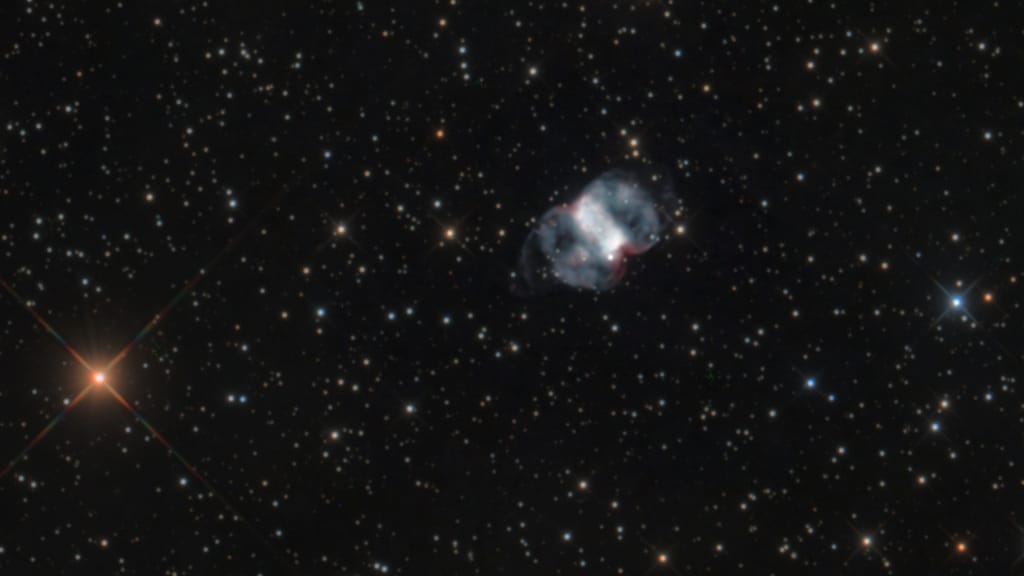
"Here, let me," said Max, and he took over the manual controls to gradually nudge M76 to the middle of the image where it belonged. With that, we were able to capture M76 for the banner image at the top of this post.
Once upon a time, M76 was a star very much like our own Sun, about the same size and mass, and it fused helium and hydrogen under enormous gravitational pressure, releasing light from that fusion energy. It was, however, some 5 billion years the older brother of our Sun, and it ultimately ran out of fuel to feed its fusion reaction. It came to the end of its life as a main sequence star.
In the turbulent throws of that death, it blew complex shells of gas and dust outward into the surrounding space, while the star itself collapsed into an incredibly dense mass about the size of the earth. It became what astronomers call a 'white dwarf' and its residual heat lit up the surrounding shells of gases and dust. In the aggregate, this is the 'planetary nebula' we see today.
If you look at M76 in the banner image up top, it looks like it is made up of a bright, thick white bar with bluish loops extending out on either side. But like 'super intelligent' rogue bots, and many other artifacts of modern life, M76 is not what it seems at first glance. The white bar is not a bar at all, but a torus viewed edge-on. Imagine you have a white sugar doughnut. Put the M76 white dwarf in the middle of the doughnut hole, and then turn it such that the hole points left and right, perpendicular to your point of view. You can't see the white dwarf because it is hidden in the doughnut hole.
But the white dwarf is blowing violent winds out the two sides of the doughnut hole, out both sides of the constriction created by the mass of the torus, and the winds inflate the dust and gas previously released when the star collapsed, giving rise to the bubbles on each side, the bubbles appearing bluish when illuminated by the heat of the white dwarf.
In Max's 1960s vernacular, "Far out, Man!"
"Okay, Max, I'll grant you corporate GalacticAI is the fundamental problem here, but we still have these Zarxbots ruining everything. I'd like to get home in one piece, if you don't mind."
"Your wish is my wish!" said Max.
On the back of a Post-it note, he coded the text message,
and he appended it to some RAM near the control computer.
"It's what we call a honey pot," explained Max. "The bots are after information and so the Library of Congress is irresistible. And just like 'Wet Paint. Do Not Touch' is the best way to get a kid's fingers sticky, 'Danger! Enter at Your Own Risk' is a sure-fire way to entice the Zarxbots to commit."
The path, however, did not lead to the Library of Congress. You probably figured that out already. Instead, Max connected the link to /dev/null, an operating system device into which they simply disappeared, nullified, one after the other, without a trace. Save for the heat they left behind in the conversion of their electrons to joules.
"Come on, Max. Time to head for home. Let's go rogue!"