A Missing Messier Mystery

"There's a trick with M102," said Max.
"A trick?" I asked. "What do you mean a 'trick'. It's a galaxy. The 'Spindle' galaxy."
"Come on, let's go, and I'll show you."
Pierre Méchain was satisfied. He had spent the Spring of 1781 keeping track of a smudgy deep sky object, a 'nebula,' in the Northern sky, a smudge he thought just might be a new comet. But it wasn't. And he was satisfied it wasn't. Over weeks of observing, it didn't move like a comet relative to other stars in the sky. Bummer. It was just another "Not-the-Comet" object like those that his friend Charles Messier was cataloging for his "Dont-Bother-with-These" list; a service to the field of astronomers hunting comets.
And so Méchain passed along the information on the new 'nebula' to Messier who entered it as M102 on his list. Normally, Messier made it a point to verify the locations of the entries in his catalog. Both his own and those contributed by others. However, the publication date for the list was fast approaching and he was under pressure to get it submitted. Well, Méchain had been contributing data for several years by this time, and his additions had always been verifiable. Under the circumstances, Messier added M102 to the list with its description, but omitted a precise astronomical location. The description noted:
102. Nebula between the stars Omicron Boötis and Iota Draconis: it is very faint, near it is a star of 6th magnitude.
And the catalog was published in the French yearbook, the "Connoissance des Temps" for the year 1784.
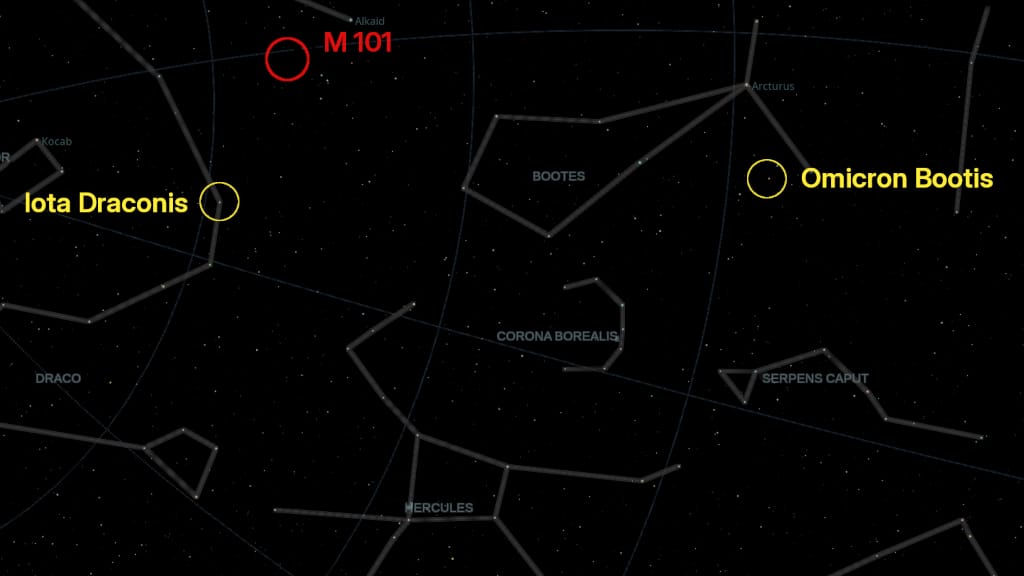
However, if you try to find M102 with this listing you run into a problem. In the figure below I have circled the locations of Omicron Boötis (in the constellation Boötes) and Iota Draconis (in the constellation Draco). These two stars are over 42° apart, a large distance, which makes them poorly suited for locating M102. Spread your arms at a 45° angle and imagine searching for a smudge in that trace of the sky. See what I mean?
In short, M102 went missing. That's pretty cool! A missing Messier mystery.
Meanwhile, back at the ranch, Pierre Méchain was no longer quite so satisfied. M102 was turning out to be a pain in the derrière. Two years after he reported M102 to Messier, and the year before Messier's catalog came out, Méchain did the equivalent of a 1783 social media post retraction, writing:
I will add only that No. 101 & 102 on the p. 267 of the Connoissance des tems [for] 1784 are nothing but the same nebula, which has been taken for two, by an error in the [sky] charts.
Oops! M102 is just an accidental duplicate of M101 (check its position in the image above) due to an unspecified error in somebody's star charts. This, according to Méchain. And he should know.
It had been a cold, cloudy spring. And when it wasn't cold and cloudy, the moon checked its shadow at the cloakroom to flood the night sky with used sunbeams, ruining any hope of deep sky imaging. So when Max suggested we travel to M102, I was all in. We hadn't imaged M102 before and it would add to my collection of Messier objects. So far I have captured somewhere around a third of his catalog.
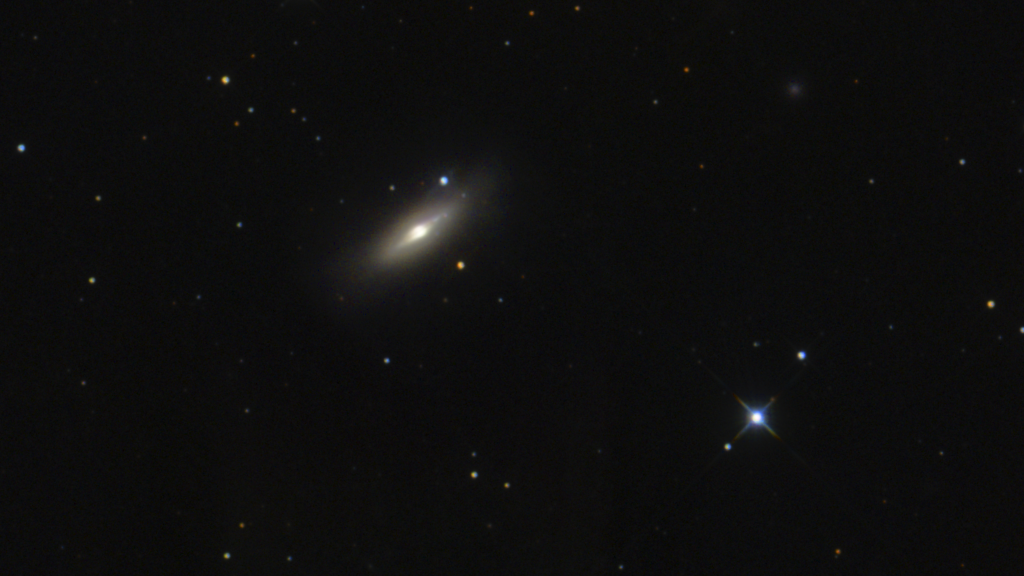
M102 is a lenticular galaxy flying some 50 million light years away in the dragon constellation, Draco. It presents an edge-on view to us here on Earth, as Max and I captured in the banner image at the top of this post. This shape is what gives the galaxy its nickname, the "Spindle." I wrote about some other lenticular galaxies briefly in a previous post. M102, however, has a couple of peculiarities.
For one, it has a distinct dust lane splitting the "lentil" lengthwise. This is common for spiral "grand design" galaxies, but is unusual for a lenticular galaxy. Our little telescope actually detects M102's dust lane, but it is pretty shy as dust lanes go, and gets washed out by the bright core of the galaxy. All of my image processing chops failed to bring it out in the final image. There is, however, a beautiful pic from the Hubble space telescope here in which the dust lane is obvious.
Anyway, it was great weather, for a change, and so Max and I assembled our spaceship telescope, aligned the mount, adjusted the focus, and brought up the autoguide subsystem. Dialing in our target coordinates, we were ready to go.
"Hey, wait a minute, Max! The scope says we're going to NGC 5866. We're supposed to be going to M102. Something's wrong."
Max just looked at me and sighed.
"What?"
Méchain's assertion that M102 was just an accidental duplicate of M101 wasn't entirely satisfactory from the beginning. In the star chart image above you can see that M101 is quite a bit outside the scope of the Omicron Boötis to Iota Draconis axis, Messier's markers for the object. Over the years, this mystery led legions of astronomy anthropologists, sleuths and documentarians to search for a more compatible solution. The question is still controversial, but here I'm relying on, and grateful for, Hartmut Frommert's analysis posted on the SEDS Messier Catalog website. See also here.
The argument goes like this. Given the large spatial distance between Omicron Boötis and Iota Draconis, it is likely that one of these notations is a mistake. In 1844, William Henry Smyth proposed that it was all the fault of the Greek alphabet. He argued that Messier's "Omicron Boötis" was actually a misprint of "Theta Boötis." You can understand that better if I write it in a Greek letter typeset:
Omicron Boötis: ο-Boötis
Theta Boötis: θ-Boötis
Miss one tiny cross-hatch, under the pressure of a publication deadline, and you go from Theta to Omicron; you are light years off. Way off in the Universe. It seems like I've been there.
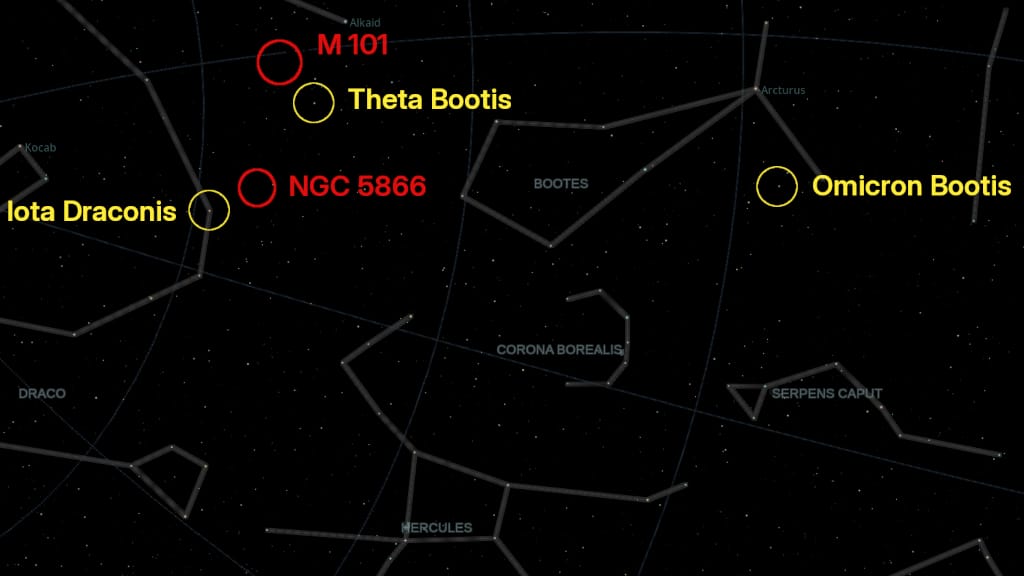
I have updated the star chart below to show the position of star Theta Boötis, which together with Iota Draconis, now narrows the search for a putative M102. Several candidates have been proposed, but within that region, the most likely suspect is the galaxy later cataloged by Herschel as NGC 5866. Most modern Messier lists consider NGC 5866 to be the original M102 entry.
Lenticular galaxies are morphologically near the middle of the family tree, with sphericals on one side and spirals on the other. M102 appeared to be a relatively quiet galaxy and we settled in on an Earth-like exo-planet, Ameriar, towards the outer Northern expanse.

It was a civilization, Max said, founded several centuries ago by space travelers, exiles, from the old planets to the East, seeking self-rule, and freedom of thought and personal belief. In recent decades, however, Ameriaren society had splintered with the apparent rise of a king, King Braspert, and an oligarchy, a kleptocracy, intent on controlling the thoughts and desires of the populace through surveillance, media monopoly, and government suppression.
"I drop in here, off and on, every so often," Max said. "I like to keep tabs."
There was a gigantic destruction site, just to our right, a hole full of rubble, teaming with construction workers who seemed to be digging holes and filling them back in again, making little progress.
"That's new." said Max. "The last time I was here that site was a building. Part of the Presidential Residence."
To our left was a row of banners and statues disappearing down the courtyard, all of them depicting the same character in various emotions of menace and scorn. The statues were coated with faux gold leaf. They'd been up long enough to start showing some flaky deterioration.
"King Braspert?" I guessed.
"Bingo! He would suck up all the hydrogen in the Hindenburg if you told him it was ego."
Just then a phalanx of uniformed thugs materialized around us. From the stone? Up from the ground? Out of the shadows of construction? They were masked and unmarked. It wasn't clear whether the acrid smell that accompanied them was material or hallucinatory. Their eyes glowed with the dull luster of old pewter, shrouded in torn packcloth. Armed with everything from knives to light-sabers, this wasn't a bridge party.
"Max! You migrant scum. You should know better than to show up here again."
The sound came from the foreground, the crew leader, corp leader, or something. He was buzzing with laser flashes leaking from his body armor, and it made him disappear and reappear in a stochastic rhythm even Dave Brubeck wouldn't be able to follow.
"Hey, Commander! Top of the evening to you. Who the hell blew up the East Wing? As if I didn't know."
"Shut your trap, Max. King Braspert had every right to tear down the woke symbol of left wing lunatics," rasped the Commander. "He is building a grand ballroom, the most fabulous in all the galaxy, probably in all the universe."
"Nice!" said Max. "And what's going to be in this grand ballroom?"
"It will be fabulous," said the Commander, "surrounded with pillars and rocket-proof glass walls. It will seat 999 dignitaries to listen to King Braspert preach. There will be a nuclear bomb-proof retreat underground with its own surgical transplant unit capable of the latest medical interventions. There will be a command center with galactic instrumentation controlling solar-wide military autonomous kinetic war robots. The roof is designed to hide snipers, the best snipers, capable of picking off insurgents at 7 kilometers."
"Very impressive," said Max. "Uh, what's with all the gold statues?"
"Don't be blasphemous, Max! Stupid! You know full well. King Braspert was sent by God to fulfill the prophesies for the Ameriaren people. The statues are works for the people, for their adoration, a reminder of the kingdom of heaven, and our ultimate ascension into the presence of God."
"So tell me, Commander. What does God's messenger need with a bomb-proof underground bunker? A state-of-the-art hospital? Eh? You think you'll be there? You'll be invited? Tell me, what does God's agent need with a military command and control center bunker? Tell me!" Max's voice rose with tempo. "Tell me! What does Jesus need with a bullet-proof ballroom?"
The Commander shifted his stance, but made no reply. His laser flashes grew dimmer and even more erratic, increasing slightly in frequency.
"Tell me!"
After a moment he said, in a low voice, almost inaudible, "You'd better go now."
The Commander's goons closed on us.
"Max" Uh ..."
"Steady, Smitty. Here's that trick I told you about."
Max punched "1783" into our telescope's control software and then clicked "Chrono" in the menu. Immediately a slight shudder ran up my shins, a tremor, a whine like the creak of rusty gears, the faint smell of ozone, and suddenly ... we weren't there.
"Jesus, Max!"
"He doesn't need a bullet-proof ballroom," said Max.
I suppressed a laugh. Smothered and suppressed into a sort of "smalaughst" coming exclusively out my nose.
"In 1783 Pierre Méchain declared that M102 didn't exist. Remember? He said that M102 was just an accidental duplicate of M101. Eh?" said Max. "Well? Wallah!"
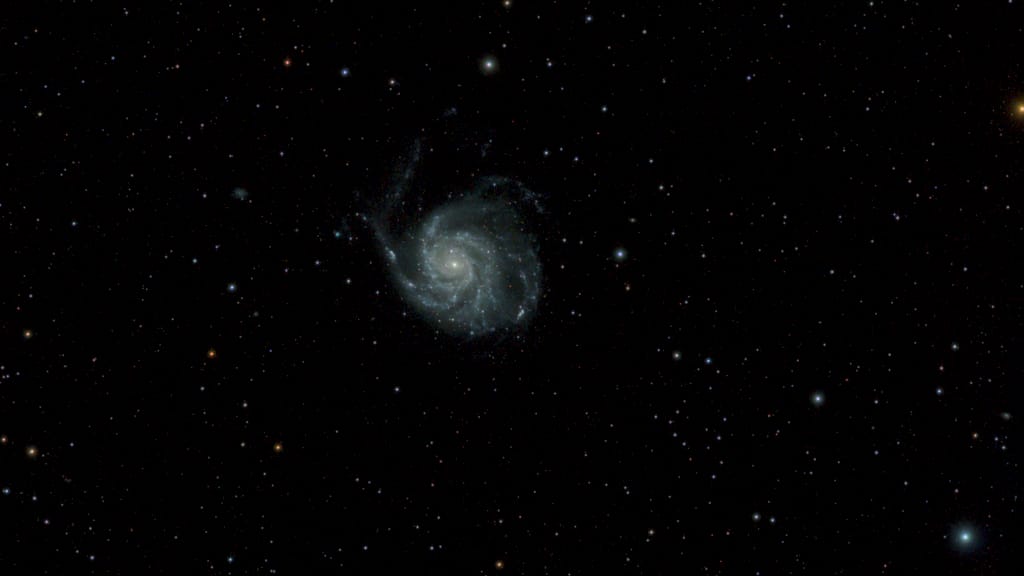
I looked out the spaceship telescope portal. There in front of us was M101, the Pinwheel Galaxy. One of the most beautiful scenes I've ever seen.