The Embrace of Ignorance

What you don't know won't disappear just because you don't know it
The early June evening had turned a little more moderate after heat and drought. The broccoli leaves looked a little less sad. A little less droopy. And so I broke for the garden to lose myself in tedium. The last planting of carrot seedlings needed thinning and it was just the sort of repetitive detail that whispered relaxed loss.
I noticed the carrots, monitored their progress, during a screening a few days ago. It is worth monitoring your carrots. If they are too little, if they are too fragile, then thinning does less good and more damage. With the support of their kin gone, they fall over, flat on the soil, bulls-eye targets for damping off, ready to die of thirst no matter the water.
These carrots, in the last spring planting, were now ready for thinning. Grown to a state where they were soon to complain about crowding, about their greedy sisters and brothers. Like siblings in the back seat of the Ford, poking each other in provocation on a long road trip to visit Grandmother and Granddad in Miami.
So I set about providing some space for the territorial carrots, aware that I was choosing which seedlings would be given the chance to express their potential and which would be returned prematurely to the earth. Care for the chosen seedlings through the rest of the season is the just penance demanded in return.
It occurred to me though, in the middle of this exercise, that I wouldn't need to spend time thinning carrot seedlings at all if I simply didn't monitor them in the first place.
Don't monitor the carrots and they won't need thinning. Genius!
Remember back six years ago? Almost exactly six years ago?
President Trump on Monday downplayed concerns of a rising number of coronavirus cases in states across the country, indicating that the increase was due to more testing.
“If we stop testing right now, we’d have very few cases, if any,” Trump said during a White House event highlighting administration actions to help senior citizens.
– The Hill, Nathaniel Weixel, 06/15/20
True to his word, on June 21, 2020, in the early months of the pandemic, President Trump ordered a slowdown in COVID-19 testing,
During the pandemic years of 2020 to 2023, the CDC estimates that a total of 868,831 senior citizens, those 65 years and older, died with the involvement of COVID-19.
Maybe they should have mainlined bleach.
They must have been tested, because otherwise the virus isn't infectious. Brilliant!
Thirty six years ago, initiated by the Reagan Administration, Congress passed the Global Change Research Act (P.L. 101-606), which created the U.S. Global Change Research Program (USGCRP) to coordinate federal research on global climate change across 15 federal agencies. Among its priorities, the Program was tasked with producing a periodic climate assessment every 4 years. The most recent is the Fifth National Climate Assessment published in 2023 on the Program's website. Since 1989 the Program also produced an annual report titled Our Changing Planet.
In April, 2025, the Trump Administration cancelled the federal contract supporting the USGCRP and fired or reassigned its federal staff. On July 2, 2025, the Program's website, globalchange.gov, was taken down. And none of this can be considered a surprise. Russ Vought foretold the future in Project 2025:
The President should also issue an executive order to reshape the U.S. Global Change Research Program (USGCRP) and related climate change research programs. The USGCRP produces strategic plans and research (for example, the National Climate Assessment) that reduce the scope of legally proper options in presidential decision-making and in agency rulemakings and adjudications. Also, since much environmental policymaking must run the gauntlet of judicial review, USGCRP actions can frustrate successful litigation defense in ways that the career bureaucracy should not be permitted to control.
– Mandate for Leadership: The Conservative Promise (p. 59)
Note the "litigation" argument. That was a new one for me. This regime's Embrace of Ignorance isn't just to keep us all in the dark, it is also to ensure easier litigation defense by the political autocracy.
Fortunately, the The Fifth National Climate Assessment was cloned by Climate.us and you can find it there. The Sixth National Climate Assessment is unlikely to happen; authors were dismissed and told the assessment was being "reevaluated" which means likely illegally cancelled. The last release of Our Changing Planet in 2024 is archived at the California Water Library. The globalchange.gov website may be archived at the Library of Congress but the portal is apparently undergoing revisions and returned an "Error 524" (timeout error) when I tried to gain access.
Remember: If we don't study climate change, the climate won't change. Brilliant!
On May 8, 2025, the National Centers for Environmental Information published a Notice of Changes entitled, "Billion Dollar Weather and Climate Disasters." It is a promise, not a threat. Here is the "Description of change" text:
The NOAA Billion Dollar Weather and Climate Disasters product will be retired, with no updates beyond calendar year 2024.
Rebecca Dzombak and Hiroko Tabuchi have an excellent article in The New York Times on the implications. They wrote:
The move would leave insurance companies, researchers and government policymakers without information to help understand the patterns of major disasters like hurricanes, drought or wildfires, and their economic consequences, starting this year.
The regime has never provided a credible rationale for this Embrace of Ignorance. In an email a spokesperson told Dzombak and Tabuchi that the halt was in response to "evolving priorities, statutory mandates, and staffing changes."
The real reason? If we retire the billion dollar disasters "product," well, then the billion dollar disasters just won't happen! Brilliant!
In early 2025, the Trump EPA said it was evaluating a rule change to stop collecting data from major pollution sources under the Greenhouse Gas Reporting Program. In September the proposed rule change was formally published in the Federal Register (90 FR 44591). It would stop required reporting from coal-burning power plants, oil refineries, steel mills, and other fossil fuel industries.
Since 2011, the GHG program has collected emissions data on March 31 for the previous calendar year, and made the data available the following fall. That appears to have ended with the Trump EPA. The most recent available public data is for calendar year 2023. Normally, 2024 data, which faced an extended reporting deadline of May 30, 2025, would have been published in the fall of 2025 but as of June 21, 2026, there are no reports available for 2024. Furthermore, the Trump EPA extended the reporting deadline for 2025 data to October 30, 2026, with the expectation that 90 FR 44591 will be finalized before then and reporting will not be required at all.
Sharon Lerner wrote in ProPublica:
“The bottom line is this is a giveaway to emitters, just letting them off the hook entirely,” said Rachel Cleetus, senior policy director with the Climate and Energy program at the Union of Concerned Scientists.
Cleetus derided the choice to stop documenting emissions as ostrich-like. “Not tracking the data doesn’t make the climate crisis any less real,” she said. “This is just putting our heads in the sand.”
Nonsense. If we don't measure greenhouse gas emissions, then those emissions are never going to be emitted! Brilliant!
Which brings me to the Ocean Observatories Initiative (OOI).
Stuff is happening out there in the oceans. And it doesn't look good.
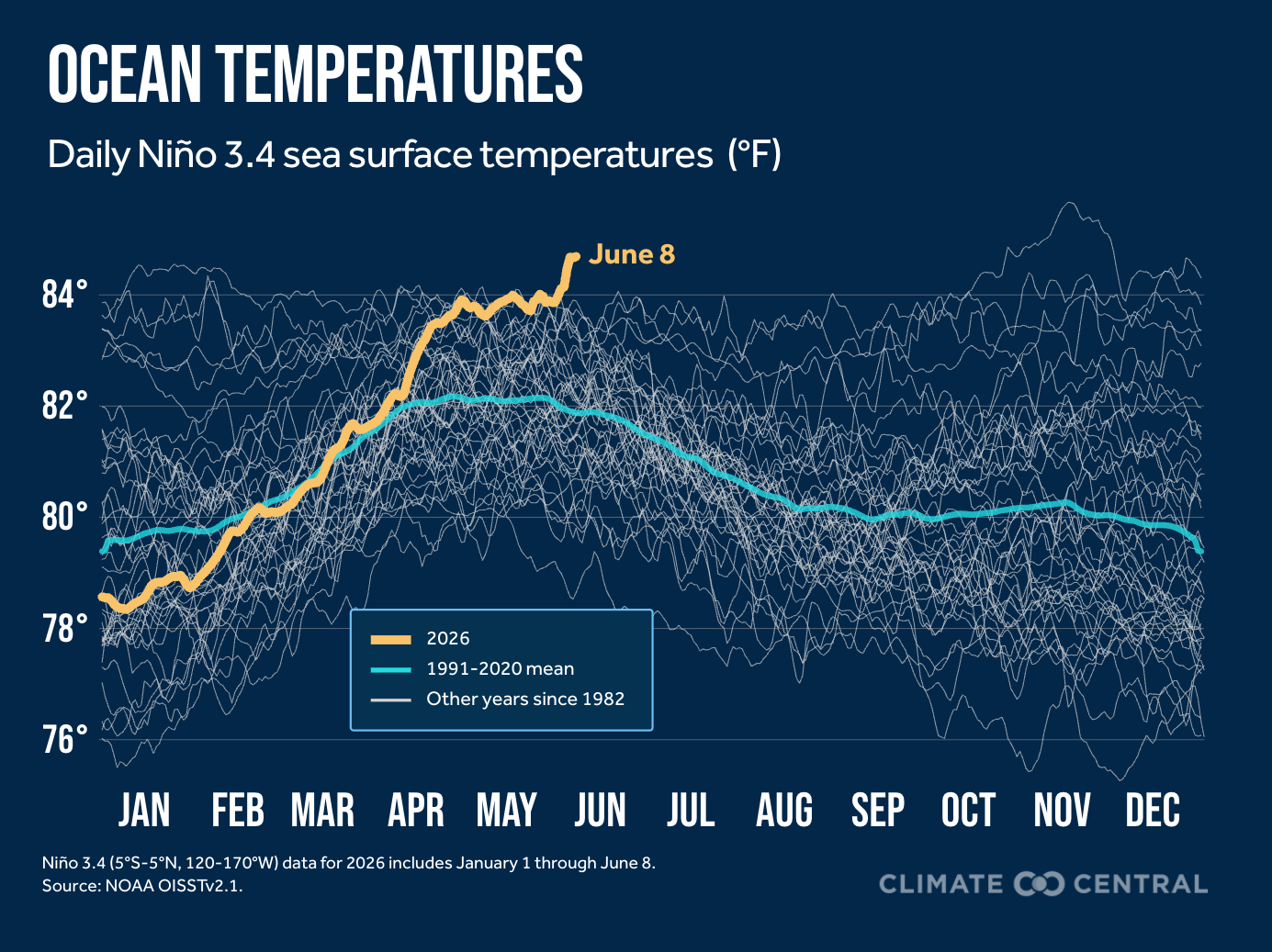
And it is non-trivial to gain a good grasp of when, where, how, or why that happening stuff is happening. But we are nevertheless in the crosshairs. Oceanographer John Delaney, University of Washington, laid it out in 2013:
Realistically, Earth is a “water-world,” and we must learn its secrets; living on the continents, we are not well positioned to do so. Furthermore, because seawater is effectively opaque to electromagnetic radiation, the oceans are very difficult to explore. Some say it is easier to map the moon or Mars with satellite laser altimeters than it is to map the seafloor of our own ocean using acoustic techniques.
Thus was born the Ocean Observatories Initiative, funded by the National Science Foundation, and commissioned in 2016 with 7 deep water ocean floor remote sensing arrays. Jessica McKenzie notes, '“Array” is the formal word for “a whole heck of a lot of instruments.” The cost of deployment was around $368 million.
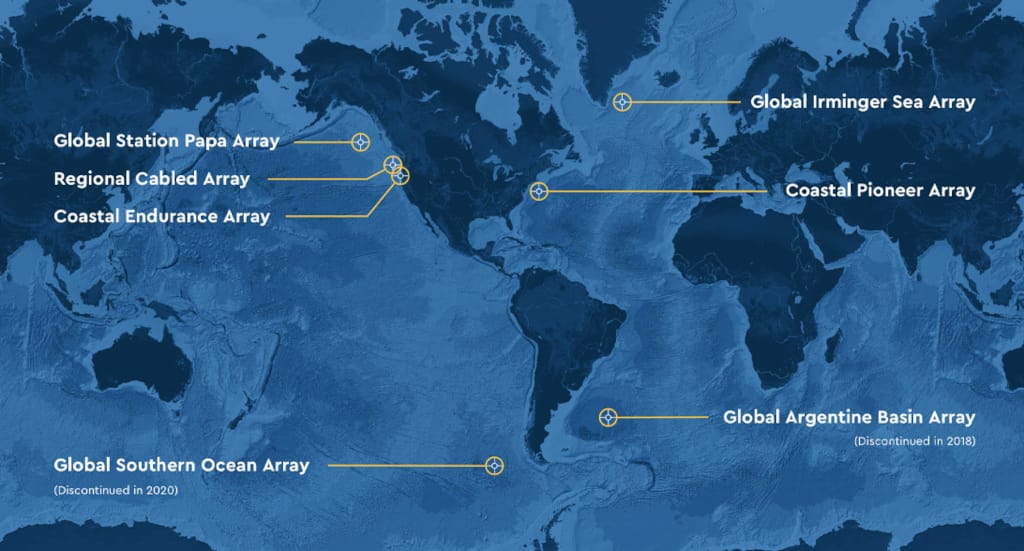
The OOI was designed to operate continuously for 25 years or more; until roughly 2041. The sites were chosen for scientific merit from community input over a decade of consultations. Here is a map of their locations:
The present configuration (more about that below) encompasses over 900 instruments that can be characterized into 41 different classes, which monitor 200 different parameters. You can do the mind boggling "by-the-numbers" thing here. Scientific highlights from just the first 3 years of OOI's operations are presented in the peer-reviewed report by Trowbridge et al. in Frontiers in Marine Science. You can find excellent summaries of the importance of the OOI to us land dwellers by Jessica McKenzie, Cathrine Rampell, Laura Paddison and Ella Nilsen, and many others, including the OOI itself.
The ocean data streaming from the 5 OOI arrays has been useful in unanticipated ways, such as allowing fishermen to monitor ocean conditions in realtime. The industry has come to rely on that data.
Wait a minute! Five OOI arrays? You said there were 7! The map up there shows 7 array locations. There must be some mistake.
Yes, yes there must be. The first Trump administration closed down one of the sites in 2018, just two years into its 25 year operational term, and it closed down the second in 2020. NSF budget cuts, you see. The two arrays NSF pulled up and sailed away were the Global Argentine Basin Array (2018) and the Global Southern Pacific Array (2020). That's two of the four "Global" arrays, both in the high latitudes of the Southern hemisphere, leaving only the arrays in the North Atlantic and North Pacific. Trowbridge et al. describe the purpose of the Global arrays this way:
The Final Network Design added foci on ocean ecosystem health, climate change, carbon cycling, and ocean acidification.
Ack! We can't measure those things! If we measure them they will only get worse! Better to remain ignorant! That way they won't happen. Southern Ocean and Argentine Basin were shut down. The remains of the other 5 sites continued to crank out data at prolific rates.
That, it turns out, was more than the second Trump Regime could tolerate.
The chronology is important here.
This spring, April 24, 2026, Trump fired all 22 current members of the National Science Board (NSB), which advises NSF and approves major awards by the NSF, including the awards for the OOI. This caused a stink and even Forbes decried what it called a "dismantling." But most criticism failed to anticipate the immediate downstream play.
Four weeks later, on May 21, NSF announced the shutdown of four of the remaining five OOI arrays.
This plan includes the removal of all in-water infrastructure from the Irminger Sea, Station Papa, Endurance and Pioneer Arrays, subject to ship scheduling and other operational constraints. All recovered equipment will be retained by the operating institution pending further guidance from NSF.
In fact, at the time of the announcement, NSF had already started removing sensor infrastructure at the Endeavor Array.
NSF called this shutdown a "descoping" (or sometimes "de-scoping") not a shutdown, because all of the old archived data will still be available. That is like claiming a ban on writing is not a ban because libraries will still be open.
With Trump suing his own IRS for $10 billion, blowing $1 billion each day on his not-a-war war in Iraq, throwing $14 million plus into growing algae in the Lincoln Memorial Reflecting Pool, and who-knows-how-much on tearing down the East Wing for a militarized ballroom, paying off $2.6 billion to stop energy companies from creating energy, well, justification for killing a $38-44 million dollar a year scientific infrastructure on budgetary grounds wasn't going to float. Instead NSF said:
"The decision to de-scope aligns with NSF's wider strategy of a nimbler approach to prioritize support for evolving scientific priorities and emerging technologies, as well as smart life cycle management within its research infrastructure portfolio."
May I have ranch dressing with that word salad?
William Brangham reported on the PBS News Hour, "One researcher I was in touch with today described this as an intentional choice to embrace ignorance."
Ok, ok. Those fishermen I mentioned? They were pissed off that their realtime ocean data suddenly stopped realtiming. They beat on Lisa Murkowski's Senate door until the pounding caused the walls of the Randolph Building in Alexandria to reverberate. Couple that with Trump backing primary challengers to incumbent Republican Senators and you had yourself the makings of a perfect storm.
On June 8, 2026, NSF announced:
Effective immediately, NSF will not proceed with further removal or descoping of equipment from the remaining arrays and will continue operations including planned maintenance. While the Endurance Array has been removed from the water, we are developing plans to redeploy the equipment after servicing.
That's progress in the war on ignorance, maybe?
Well, that's not clear. NSF plans to solicit input from "stakeholders" and appoint an "expert panel" to review the OOI. So our fishermen better count the silverware. NSF hasn't had a permanent director since April 25, 2025, and the current Trump nominee is considered by some to be unqualified, and conflicted, and a threat to science. Which fits right in with the White House cage match. Now, with the National Science Board membership fired, and a new one modeled, perhaps, after the Trump-Epstein-Kennedy Center board, things are looking rather unfavorable for the future of the OOI.
Here's the thing I don't understand. Why deliberately embrace ignorance?
I could understand farmer Elon Husk spending billions to buy up the government in order to prohibit the monitoring of carrots so they would never be thinned. Husk would then monitor his plantings, thin the seedlings, and end up with a monopoly on the exploding carrot market.
But that is not what's happening. The carrot data is being withheld from everyone, Elon Husk included. Maybe he thinks he can grow carrots on Mars after they all perish here on Earth? Maybe he thinks he has enough canned carrots squirreled away in a hardened underground bunker to last a billion years?
What kind of ignoramus deliberately wishes to continue, to actually increase, their ignorance? Not just wishing ignorance for others, but bringing it on themselves. The gains harvested from national ignorance for the ignorant 0.1%ers is so short term, surely it can't be worth accelerating billion dollar disasters, even for billionaires.
Why are those who know better playing along, doubling down on ignorance for themselves? It only yields compound ignorance.
Me? I will continue to monitor my carrots. And our nation should too.