Stealing the Common From the Goose

The law locks up the man or woman
Who steals the goose from off the common
But leaves the greater villain loose
Who steals the common from the goose.
– Anonymous, "The Goose and the Common"
I started writing about Reflect Orbital as a mental health distraction from the real-life Pirates of the Caribbean committing murder in the Gulf of America. I imagined that putting up a big mirror in orbit to reflect sunlight onto solar panel farms would turn out to be rather silly. One post, I thought, and I could get back to important things like Marco Rubio and the Font Wars.
In that first post I recounted the failed reflector attempt with Znamya 2.5 by Russia, and introduced the US company Reflect Orbital. But their PR claims were so bogus I had to write a second post just to clear up how and what could actually be done. At least in theory. In a third post then, we explored the markets where Reflect Orbital might find success or failure.
And that's when it became frightfully clear that Reflect Orbital has venture capital backing, support from the military, and a short-term market selling expensive boutique light shows to billionaires and Corporate Inc.
And so here we are, despite the silliness, very likely to face these blinkin' baubles lighting up our skies uninvited. In this last post, I want to highlight the harm inherent in letting Reflect Orbital steal the night right out from over us.
Not the better mouse trap
Right at the top, let's posit that reflected sunlight to run solar farms a little longer each day is unnecessary. Earth based energy storage systems, to provide electricity when the sun isn't shining, are already up to the task and are likely to be far more economical than flying Mylar will ever be. My opinion.
Here's a plot of the price of lithium ion storage cells over the last decade:
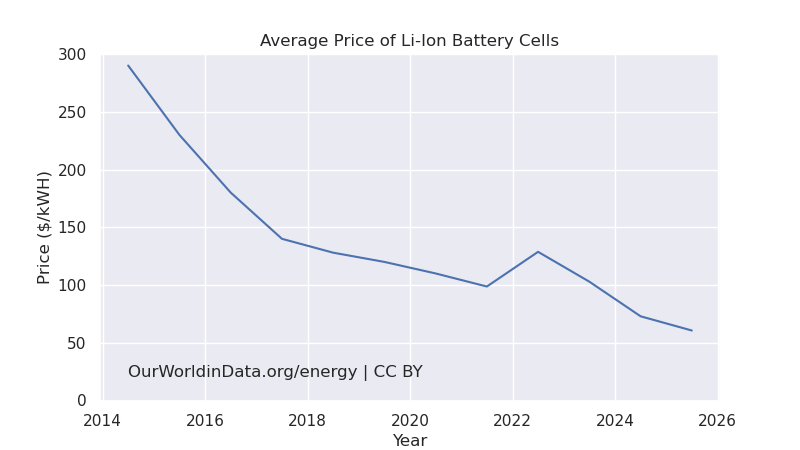
Prices have fallen dramatically just since 2022, when the McInnis group did their economic analysis, down roughly 40% over that time. Solar, wind, hydro, and storage are already economical pathways to 24/7 electricity. In doubt? I recommend Bill McKibbons recent book, "Here Comes the Sun."
The peasants are revolting
Not surprisingly, astronomers become alarmed when threatened with the loss of their livelihood. After the Znamya experiments became known in 1999, Vladimir Syromyadnikov felt compelled to publish an open letter "to astronomers professional and amateur" in response to letters of complaint:
… the most part of them being too emotional, some containing groundless accusations and even (what a shame!) offensive language aimed at us ...
The modern response to Reflect Orbital has been equally harsh. Here's a Fact Sheet posted by a group of astronomers on the dangers of the operation. I happen to agree with them.
But most of us are not astronomers. Every astronomer on Earth could disappear tomorrow and it would never be noticed by demographers.
So let's start with us. All of us.
If we can't see, we won't see it coming
There is a lot of stuff out there in space. And not all of it is innocuous. NASA's Planetary Defense efforts have identified 40,155 near-earth asteroids as of December, 2025. Of those, over 11,000 of them are larger than 140 meters (459 feet) in diameter; almost one and a half football fields across. That's a big bomb. NASA estimates another 14,000 of that size remain to be identified.
We don't have to go back 65 million years ago when a mile wide asteroid impacted the Yucatan Peninsula, causing the extinction of the dinosaurs and much of the rest of Earth's species. Here's a more recent example, just shy of 13 years ago.
On Feb. 15, 2013, ... a house-sized asteroid impacted Earth’s atmosphere over Chelyabinsk, Russia, at a speed of eleven miles per second and exploded 14 miles above the ground. The explosion was equivalent to 440,000 tons of TNT, and the resulting air blast blew out windows over 200 square miles, damaged buildings, and injured over 1,600 people – mostly due to broken glass. Due to the asteroid’s approach from the daytime sky, it was not detected prior to impact ...
– NASA
That blast was in the middle of Almost Nowhere, and the Chelyabinsk asteroid is estimated to have been only about 18 meters (59 feet) in diameter.
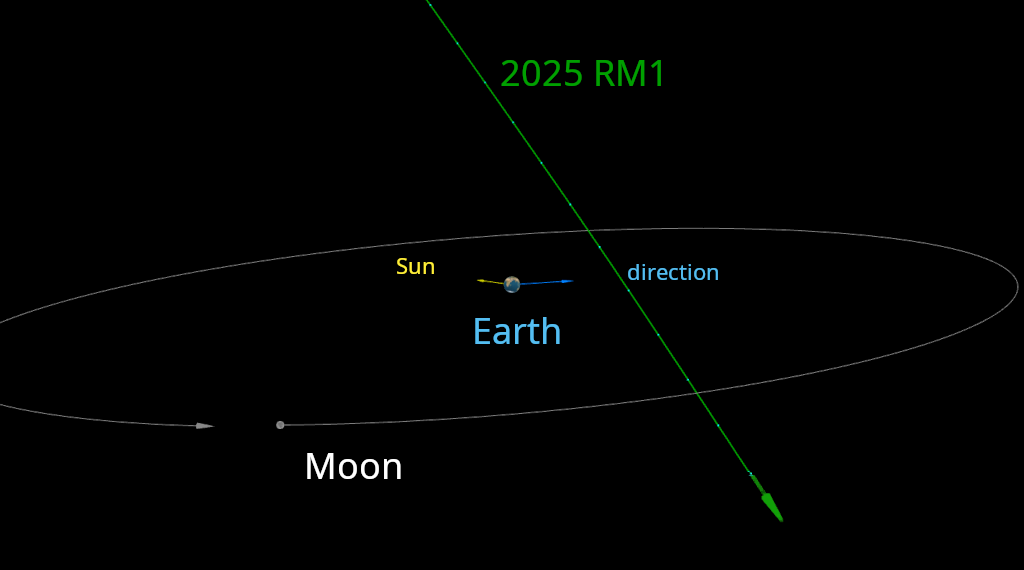
This past September 3, 2025, a larger space rock – estimated at 31-69 meters (100-226 feet) in diameter – flew by Earth, missing us by only 64,191 miles at closest approach. Roughly one quarter of the distance to the Moon. I've depicted its path in the banner image at the top of this post. The Earth, the Moon, and the Moon's orbit are shown, with the direction of Earth's travel indicated by the blue arrow, and the orientation to the Sun shown in the yellow arrow. The path of the asteroid, named "2025 RM1" is shown as the green arrow. Close shave.
"2025 RM1" was first detected by telescopes at ATLAS-HKO, the Asteroid Terrestrial-impact Last Alert System (ATLAS) observatory in Haleakala, Hawaii. I've written briefly about this surveillance system before. Okay. The asteroid was detected, all right. But not until September 4 when it was already past us.
The advanced warning time provided by ATLAS-HKO should be roughly one week for objects 50 meters in diameter; even longer for larger objects. Unfortunately, the detection efficiency for objects larger than 50 meters is only about 60%. And here's the reason:
Most of the remaining 40% are approaching from the direction of the Sun and can not be seen in the night sky.
That is, the hard to find asteroids are discovered, if they are found at all, during the morning and evening twilight hours.
Aerospace as a junkie
Reflect Orbital will impair our planetary defense in at least two ways. The first is through clutter.
Today there are approximately 14-15,000 satellites in low earth orbit. That number has been increasing exponentially since around 2019 and is headed towards 500,000 over the next decade. And that just counts launches currently seeking regulatory approval. Reflect Orbital, at its stated build-out, would contribute another 250,000 satellites to the mix.
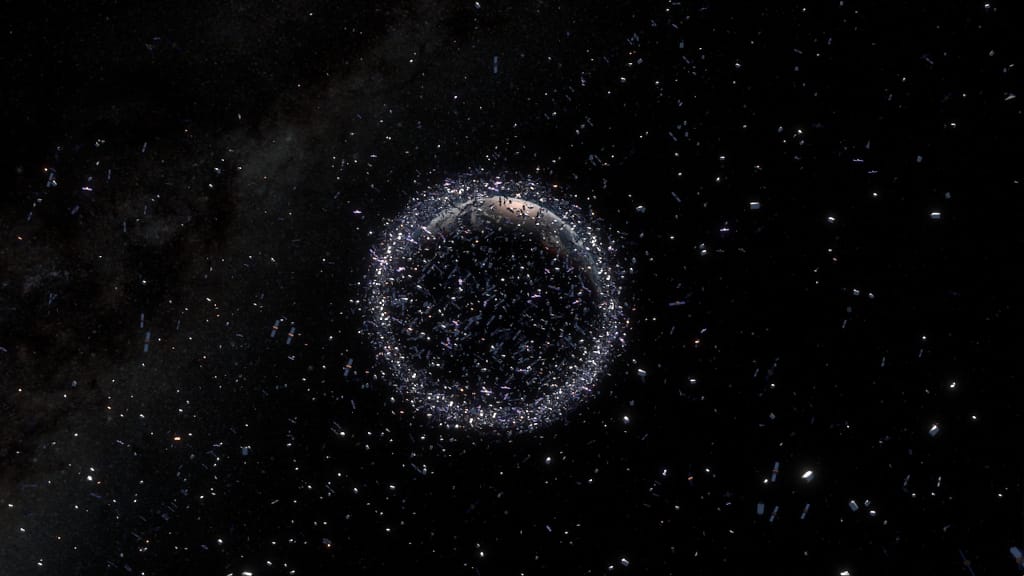
What happens when two of these objects collide? Traveling at roughly 8 km/sec (18,000 mph)? The force involved produces annihilation:
Almost no known structurally solid materials can withstand such an energetic impact. Most of the satellite would be instantly vaporized by the collision and broken up into myriad pieces ejected at force in all directions.
Fragments flying apart in unscheduled orbits are then likely doomed to collide yet again with other objects, each collision increasing the density of space junk.
Back In 1978, NASA scientists David Kessler and Burton G. Cour-Palais, studied the database of known space objects at the time, and warned that the increasing density of objects could lead to a run-away cascade of collisions that could render space, especially low Earth orbit, unusable. This paradigm is called the "Kessler Syndrome."
Early last month a piece of space junk actually hit the Chinese spacecraft Shenzhou 20, damaged the craft, and delayed the return of astronauts from the Tiangong space station.
Just two days ago, Dec. 12, SpaceX reported that a Chinese payload, launched on Dec. 9, came within 200 meters of taking out one of their Starlink satellites. In fact, dodging space objects is big business. Search for "satellite avoidance maneuver" and you will pull up a trove of proposals and algorithms for automated collision avoidance. SpaceX recently reported that the average Starlink satellite makes 44 avoidance maneuvers per year as of 2025; almost one each week.
Indeed, Thiele et al. have proposed the parameters of a "CRASH Clock," analogous to the nuclear doomsday clock, marking the elapsed time before the occurrence of a space crash in the absence of avoidance maneuvers. It currently sits at 2.8 days. Other than that, not a lot seems to be going on to reduce the rubble.
Reflect Orbital is by no means the sole proprietor of this problem, but the addition of thousands of Reflect Orbital satellites will make a marked contribution to turning low Earth orbit into a compost pile.
There is no OFF switch
Reflect Orbital's second contribution, in service to destroying our planetary defenses, is unique, and it is the injection of thousands of high beam headlights into the twilight sky.
In a recent evaluation in the journal Nature, Borlaff, Marcum and Howell note:
… some critical scientific programmes, such as discovery surveys for unknown hazardous Earth orbit-crossing asteroids, can only be conducted through twilight and sunrise observations ...
And those are precisely the hours when Reflect Orbital's 4000 (or 250,000) mirrors will be reflecting sunlight down from the sky. All around the terminator. Around the Earth.
The clever part is that Reflect Orbital's mirrors won't have shutters. They can't turn them off. So when one of their satellites travels beyond its target site, it will have to manipulate the mirror, either searching in preparation for the next target, or swinging the beam one way or another, sweeping off through a couple hours of someones darkness or twilight, or plowing a furrow of light ahead or behind. Thousands of satellites. If you forget them, they will remind you. Every 4 minutes.
This will impair, if not blind, ATLAS and every other planetary defense observatory around the World. And the impact of the Borlaff et al. analysis is that this pollution will not just affect ground-based observatories, but space satellites as well.
A bad case of jet lag
Life on our little blue orb has been evolving for roughly 3.7 billion years, give or take a weekend. And it has encountered regular nighttime and sunlight cycles on every day of every one of them. Those of you who have endured jet lag from being transported rapidly from one time zone to another can attest to the reality of this influence on our lives. Called "circadian rhythms," light entrained bio-cycles have evolved not just for human health, but the lives of other animals, plants, fungi, and even cyanobacteria.
The effects of disrupting light cycles by orbital solar reflection, are barely given lip service by proponents, particularly for natural environments where organisms cannot simply pull the blinds. In his NASA proposal, Billman et al. dismiss the threat of disrupted light cycles in a hand-wave:
Those living in the northern regions of the Earth have, in fact, lived comfortably with six months of even more intense perpetual daylight per year. It would not appear to be a serious psychological problem to most of us based upon this experience.
Well! Of course. Ecosystems? We don't need no stinkin' ecosystems.
I won't try to catalog all of the scientific studies on light, circadian rhythms, and animal and plant growth and behavior. The issues are incredibly multi-factorial and complex. But in truth, we have very little idea what a world-wide alteration in sunlight patterns would do to the ecology of natural habitats.
As for Research Orbital, they are quoted in Space.com as being all in favor of environmental impact assessments:
Reflect Orbital's spokesperson said the company intended to conduct an environmental impact assessment before building up the constellation and hopes to use the demonstration mission next year to "collaborate with experts to better understand ecological sensitivities at each service site."
Each service site? Presumably the "10 iconic locations" on their "limited World Tour" lighting experiences." Did I mention we are entertaining a world-wide alteration in sunlight patterns here? Literally the entire World. Or, at very least, all those parts of it that pass under the terminator twice a day.
You'll poke your eye out
When built out to support solar farm generation, Reflect Orbital's constellations of mirrors will be beaming roughly 20% of daylight intensity to a spot on the ground that is miles in diameter. Ever look directly at the Sun? How about when a solar eclipse is 80% of total? No, I didn't think so. That intensity of light will irreversibly damage your eyes, with the possible exception of the President of the United States, of course.
The obvious solution as far as Reflect Orbital is concerned? Just don't look at it. Here's what Ben Nowack, Reflect Orbital's CEO, told Thodey Campion in 2022:
We’re designing ours to be as bright as the sun or less. Even if you shoot light in the wrong spot, there’s no way for it to be brighter than the sun. So yeah, there’s not much of an issue there.
Not much of an issue there.
Sunlight strobing about the sky from places where no Sun has ever strobed before. Dark adapted eyes? Just don't look at it. Is it blinding your windshield from out of nowhere? Just squint. Youngster in a crib? Use a blanket when you see it coming.
In a hypothetical future court case, it would not surprise me to find Nowack's statement as Exhibit A in support of the charge of willful negligence.
But the build-out doesn't need to be that large to be a problem.
Let's take the one 54 meter reflector. That satellite is calculated to deliver 67 milliwatts (mW) per square meter of light at ground level. That's nothing. Our living room light bulbs are rated in watts, not milliwatts. So 67 mW per square meter means my little 150 mm (6") reflector telescope will capture about 1.2 mW of light from Reflect Orbital's mirror.
Now here's the fun part. My telescope will focus that 1.2 mW of point source light down to a spot that is about 37 microns in diameter on the camera sensor. Better telescopes can gather exponentially more light and achieve much tighter focus. But even with my humble instrument, the light intensity of that spot works out to roughly 1 megawatt per square meter. That's not good for my camera. It's even worse if you are looking through the telescope with your eye.
Don't play with that, you'll poke your eye out.
If you are not here, raise your hand. Thanks for following this far!
I confess I wrote this litany of dangers precisely because they are besides the point. Rather they bolster what should be the focus, and that focus is more universal than the fate of astronomy.
The night sky is our commons.
Yours and mine.
The stars, the galaxies, the Milky Way are our commons. Sight of them belongs to us. By divine right, tradition over hundreds of thousands of years. That commons shapes our cultures. It is especially apropos to proclaim this truth now, this time of season, when we seek the heritage of our own individual stars.
Reflect Orbital intends to steal that commons, destroy it, in pursuit of profit by selling – by "commoditizing" – sunlight.
Theft of the commons is not new.
The lede verse of this post dates from the English closures in the late 18th century. In the US in recent memory, previous thieves attempted to steal our birds, literally steal the geese off the commons, by poisoning it with DDT in the 1950s. They stole our rivers, pouring so much waste into the Cuyahoga River over the years that it caught fire on multiple occasions, making the cover of Time magazine in 1969. In 1977, we found out that thieves had abandoned their toxic dumping ground in Love Canal, a neighborhood not far from where I was born, abandoned because it was so toxic it was an environmental disaster, displacing families and leaving them with chronic illness.
There is no difference in the thieves we face today. The difference now is in our leadership.
In the past, the response to Silent Spring, to Cuyahuga, the response to Love Canal, and the response to a variety of other thefts, the response of leadership was to at least attempt to stop it. The Nixon administration (!) and Congress created the Environmental Protection Agency. Congress passed the Superfund Act in response to Love Canal.
Now, instead of preventing the theft of climate, our leaders solicit $1 billion bribes from the thieves themselves. Instead of guarding our cultural commons, thieves are allowed to steal our art and literature to make profit off of chatbots. Instead of protecting the water in our aquifers, tech bros are encouraged to steal it right out from under us, the better to run data centers to enrich themselves. And with VC and military funding, Reflect Orbital is encouraged to steal the commons of our shared night sky.
The difference now is in our leaders. And in ourselves for putting them in positions of responsibility.