Edelweiss


We entered Union Station through an atrium on the west side of the building. Sort of "blown in" to be more accurate. I've since gathered that this is the route designed for users of the local Metro trains, though it wasn't obvious at the time. We wondered past the West Hall and into a small clot of stores, "Pret," "Sbarro," "Cinabon," and the like. From there it was into a vast nondescript emptiness whose dominant feature was a central, short escalator leading up to a platform walkway, which would then lead to a Hitchcock-like, vertigo-inducing set of escalators leading up into the clouds, and thence – if you let them carry you upward – into the belly of the aircraft carrier previously known as "Parking Garage." We've been there, done that. Not our destination at the moment.
We checked the notice board. The Vermonter was "On Time" but that was the sum total of the posting. Along one side, the Vast Emptiness faced forbidden entryways, the "Gates" labeled "A," "B," "C," and so on. Eventually, with luck, the Vermonter would show up with its own personal letter of the alphabet. But we had a bit of a wait, and so we looked around for a place to rest our luggage and sit down.
Once upon a time, long long ago, in a Union Station far far away, the Vast Emptiness boasted benches and rows of uncomfortable interlocking industrial chairs on which to sit and wait for the alphabet to claim your train. But now, there were only tangles of short metallic pillars in each section, strung with black restraining tape from post-to-post, an arrangement designed to herd livestock in back-and-forth zig-zag meanders, all around the space before reaching the forbidden entryways of the alphabet.
On closer perusal, we discovered one visible sign of seating: inside a glass walled cell block near "Hudson News." And so that's where we went. We were greeted by a pleasant young Amtrak employee who asked us what the hell we were doing there. So we told him we were looking for somewhere to sit down while we contemplated the alphabet.
"Oh! This is for Red Cap Service only." he said.
"Is there any place for passenger seating?"
"Yeesss..." he hesitated. "You want to go out, turn right, stay straight ahead, then bligsddf in the sdfinges, your first round over, and it's there on your left."
The Scarecrow from the Wizard of Oz couldn't have been clearer.
So we headed off in the direction he last pointed. Sure enough, further down the Vast Emptiness there was another cell block with seating, somewhere approximately where we thought it was supposed to be, and so we went in. This time we were greeted by another pleasant young Amtrak employee who asked us what the hell we were doing there.
"Oh! This is the Metropolitan Lounge," he said, "Reserved exclusively for Amtrak Guest Rewards Select Executive and Select Plus members." He paused, "And Acela First Class passengers. Are you on the Acela?" We didn't look like we were on the Acela, let alone First Class passengers.
"Well no, we're waiting for the Vermonter."
"Too soon." And he shook his head in a matter-of-fact, left-right, up-down, bobbing motion.
"Is there any place for passenger seating?"
"Yeesss..." he hesitated, and started to direct us back to the Red Cap Service area.
"We've been there," we explained. "And while I'm sure it is very red, they wouldn't let us in, and they sent us to you. Now you are sending us back to them."
Convinced he was dealing with the least intelligent set of humans he'd ever encountered, he walked us back toward the Red Cap glass cell block. But just before we reached Hudson News again, he pointed us down a left-hand corridor and there, hidden off at an angle, was a final glass cell block, somewhat larger in scope, with future passengers inside. Seated.
We entered the "Ticketed Passenger Seating" cell block. (Which implies, incidentally, the existence of "Unticketed Passengers" out there somewhere unseated.) At the front desk, behind a barrier, was a very nice Amtrak lady whose role it was to keep pace with the trains and their alphabet. She already knew what the hell we were doing there from long experience. We told her we were waiting for the Vermonter, of which she seemed to approve, and so we took our seats to wait.
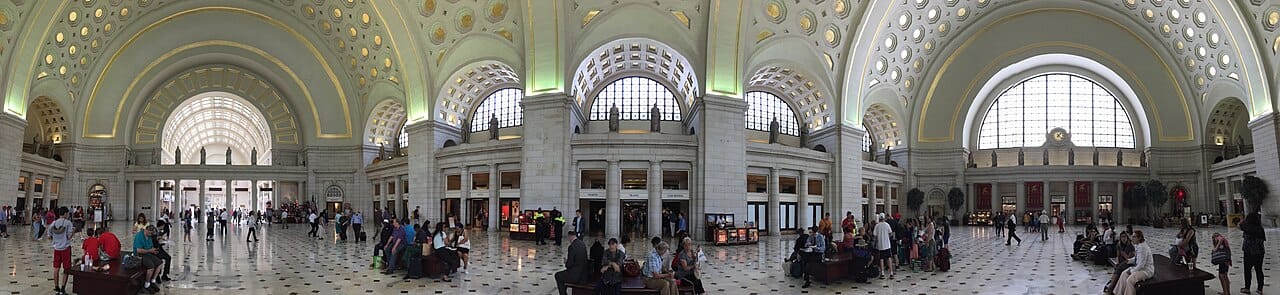
Washington Union Station is an impressive building. I have reprized our expedition through its bowels for the purpose of establishing something of the scale of the thing.
In the banner image up top, there is a panorama of the Main Hall as seen after a 2016 renovation. Together with the East and West Halls, they live behind Hudson News, and the Vast Emptiness, more central to the overall building. In this image the camera starts off, on the left, looking towards the West Hall, and then spins around inside the Main Hall to end up looking towards the East Hall on the right.
That's some expansive space, with tiny pedestrians littering the marble plain. Here's the thing.
You can rent the Main Hall for your birthday party or wedding reception. (Not as dramatic as renting the entire city of Venice, I'll grant you, but still.) Should you decide to do so, if everyone you invite can stand up the whole time, you are restricted to a guest list of just 3,472 people. If you want to provide your guests with a chance to sit down? Well, you'll have to cut back to only 2,200 people.
Got it? That expansive Union Station Main Hall: 3,472 people. Maximum. And all standing.
Like the U.S. Postal Service and Amtrak itself, Union Station has had its ups and downs. The railroads, various management companies, and Amtrak have all had a swing at the plate. Last August 27, 2025, Transportation Secretary Sean P. Duffy announced that the Trump administration would negotiate to "reclaim management" of Union Station. A concept of a plan.
As it turns out, that was a busy August 27, 2025. That's the day on which Trump met with Tony Blair and Jared Kushner to discuss plans for post-war Gaza. The Director of the CDC, Dr. Susan Monarez, was canned less than a month into her term. And tariffs on India were raised from 25% to 50% because Prime Minister Modi wouldn't vouch for Trump over the Nobel Peace Prize, would not recount all his derring-do, by which DJT had metaphorically ended the latest war between India and Pakistan.
And just 2 days earlier, on August 25, 2025, the National Guard troops that the Secretary of War had assigned to pick up trash around the Lincoln Memorial, started carrying M4 rifles to enforce Trump's anti-crime agenda.
In August, 1938, the von Trapp family boarded a train that would take them from Austria to Italy. In a sense, this would be the start of their own "Vermonter", though the birth of Amtrak was still 33 years off in the future. For, at the end of their travels, they would find a new home in the gentle mountains surrounding Stowe.
The story of the von Trapp Family Singers has been Rogers and Hammerstein'ed to fit into the limited container of a Broadway musical; the family did not escape the SS by climbing over the mountains carrying luggage and instrument cases. But the essence of the story, the bones of The Sound of Music, its meaning and import, are largely authentic.
Austria in the 1930s was beset by political upheaval, violence, and civil conflict. Bank collapse and the Great Depression spawned severe economic stress. The German and Austrian Nazi parties trafficked in disinformation, manipulating church and state, fomenting disruption.
On March 12, 1938, the German army crossed the Austrian border and the next day Hitler annexed Austria into the German Reich completing the Anschluss, the reunification of Austria and Germany. Not a shot was fired.
A plebiscite referendum was called on April 10 to ratify the Anschluss. The late historian, Evan B. Bukey, University of Arkansas, noted that most of the polling stations for the referendum were manned by uniformed storm troopers, and that ballots were generally marked in public, not in secret. Roughly 8% of the electorate, about 360,000 voters, were disenfranchised as communists and socialists, or citizens of Roma or Jewish origin. With 4,471,618 votes cast – a 99.71% turnout of eligible voters – the result was 99.73% "Yes" in favor of German Nazi rule. A look at the ballot provides an additional inkling of why.
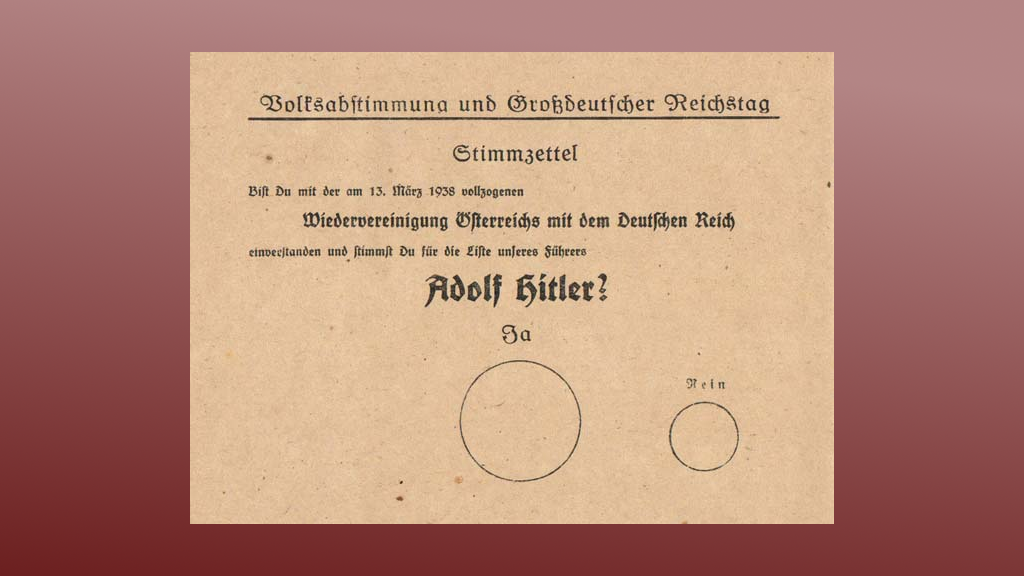

"Do you agree with the reunification of Austria with the German Reich that was enacted on 13 March 1938 and do you vote for the party of our leader Adolf Hitler?"
-- Voting ballot from 10 April 1938
Over the next few weeks, some 72,000 Austrian dissidents were rounded up, many detained in a makeshift concentration camp set up in an unused Vienna train station. On August 9, detainees from the Dauchau prison camp near Munich, began the construction of a new slave labor camp near Mauthausen, Austria.
The camp eventually grew to include facilities for the SS as well as barracks, an infirmary, brothel, gas chamber, and crematorium. The Mauthausen complex included many satellite camps and forced labor concerns in the area. Many prisoners were forced to work in industries such as granite quarrying and airplane construction.
– International Holocaust Remembrance Alliance
The von Trapp family had good reason to leave the country. The head of the family, Baron Georg von Trapp, was a retired Austrian Naval Officer, and he refused a commission in the German Navy. Furthermore, the family declined to perform at official Reich functions. Refused to have their songs censored by the regime.
And so that August, they bid farewell, so-long, to Salzburg, and left Austria on the train to Italy. Bless my homeland forever.