Lettuce Rejoice

It was a rare soft March afternoon.
The sunlight gave warmth to old shoulders and the incessant roar of the wind through bare tree branches had died down, after weeks of dominance, such that I was newly aware of birdsong filling the woods. On the roller-coaster of spring weather, we were up from the depths of long weeks of ice and briefly able to see the promise of more pleasant days somewhere out ahead. Soon enough.
The dirt in the garden bed was moist but still bone chilling on my fingers, working to sculpt new digs for the lettuce sets. The ground teased the faint smell of old mulch, pulled weeds, and new beginnings.
I had an early start with lettuce sets this season. I mentioned that a few posts ago. And they did well. I nurtured them under artificial lights from the last days of December, until they started getting pot-bound, complaining of pinched toes and fallen arches. It was time to turn them loose in the garden.
This particular bed bragged on its carrots last season, and so the rotation this season calls for Not-the-Carrots, a role easily played by lettuce varieties over the next several months.
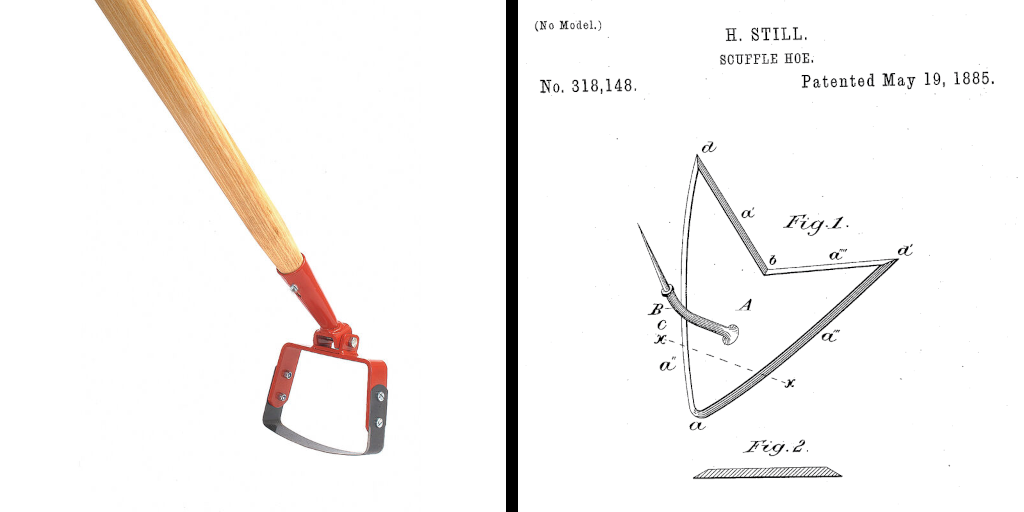
I raked up the covering of fallen oak leaves and residual straw mulch, spread some compost, and scuffled up the mix with a hoe, a bent flattened loop of sharpened steel attached to a long handled pole, a "scuffle" hoe, which does exactly what its name implies. Although, I just learned, this should properly be called a "stirrup hoe," allegedly invented by one Jethro Tull in 1791. I am in good company in this mis-attribution though, for to quote from the company Neversink Tools:
Stirrup hoes, sometimes called hula or scuffle hoes, are a favorite for getting out more mature and stubborn weeds from your farm and garden.
It turns out, of course, there is an official "scuffle hoe" but it is inextricably tied up in the US Patent Office as "US318148A," filed by one Henry Still in 1885.
Be it known that I, HENRY STILL, a citizen of the United States, residing at Beloit, in the county of Mitchell and State of Kansas, have invented certain new and useful Improvements in Scuffle-Hoes
Still's design is an arrowhead-shaped cutting blade attached to a short handle.
Like many patents I've read, Still felt the need to write far more words explaining why his arrowhead-shaped tool was not the same as all the other arrowhead-shaped tools already out there on the market, than he did in describing his actual invention.
With the garden bed prepared, I covered the soil with a sheet of thin perforated black plastic to warm the soil in the early weeks, suppress weeds, and keep the lettuce heads clean from dirt kicked up by the rain. I suffer guilt trips for this fossil fuel pandering, but console myself with the excuse that I reuse the same sheet of plastic for many years in a row.
Botanical Raiders of the Lost Ark have traced the origins of lettuce back 5000 years, in round numbers, to the Caucasus, not far from where we found the birth of spinach a few posts ago. From DNA sequence evidence, the lettuce laying claim to the title of The World's First Lettuce is Lactuca serriola, known as "Prickly Lettuce." Today, Prickly lettuce is found all over the world with 70,662 observations recorded in iNaturalist. It is mostly left to itself.
At first no one thought to eat lettuce in a salad. Instead, it was grown for its seeds, which could be pressed for cooking oil. But eventually the leaf found favor with the Egyptians, who worked to breed varieties without spines, and thus old seed-crop lettuce became modern leaf-crop lettuce.
The ancient Romans, always appropriating much from the ancient Egyptians, were big on lettuce too, and it spread to Europe and North America, all along the way being squeezed, and crossed, poked, and coaxed into loose leaf, Romaine, butterhead, and many other subdivision varieties.
I first collected lettuce seeds by accident. By sloth, truth be told. One of my old lettuce plants decided it was too freakin' hot to produce edible lettuce leaves and so it bolted in a last ditch effort to have some reproductive fun and become immortal. It gave away the gig with a changing habit, but I was too busy arguing with Downy Mildew on my cucumbers to take any disciplinary action. And so it went to seed.
As I have been painting this picture of lettuce, you have probably been imagining a squat leafy bundle of a plant that is, maybe, 12-14" tall. A physiognomy similar to all the denizens of the refrigerated shelves of the local supermarket. That was certainly my idea of lettuce, having grown it for the table over the decades.
It turns out, a lettuce – caught in the hormonal maelstrom as the teenager – that lettuce forgoes all common sense and begins a mass dash for the stratosphere, the better to make its flowers the highest, most elevated attractants to pollinators for miles around. My poor, forgotten lettuce bolted to be almost 4 feet tall.
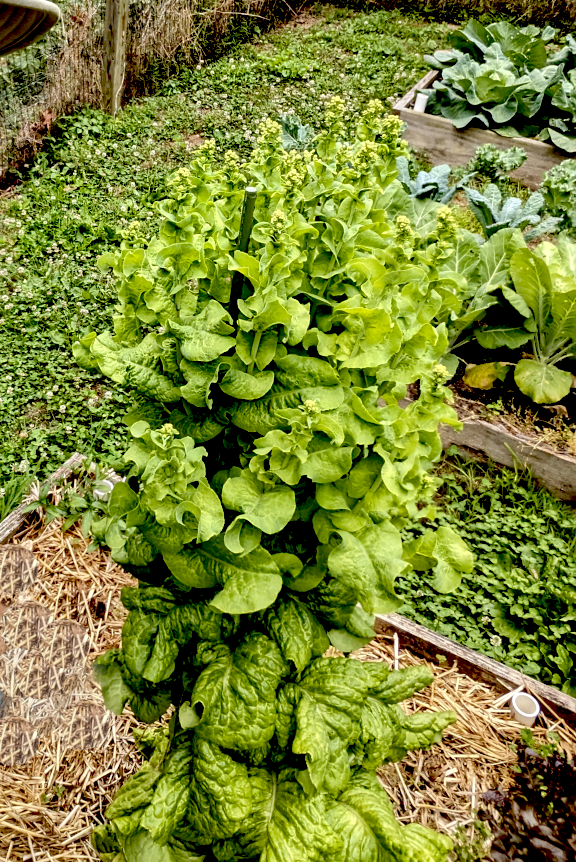
Towards late summer, the pods fill with mature seed attached to fuzzy fluff, which threatens to carry them all off on the slightest breeze. And they would, too, if the pods shattered. I was concerned about this the first year and so I harvested a lot of seed way too early. I needn't have worried.
Exploding seed pods were a major selective advantage for the Prickly lettuce because it would propel packets of seedy astronauts out into space to go where no Prickly lettuce seed had gone before. The odds were that some would find new homes suitable for carrying on carrying on. It beat just falling to the ground where the Prickly lettuce generation of Baby Boomers had already used up most of the resources.
But pod shatter was inconvenient for the farmer who hoped to save some seed for a rainy day, and so they came to an agreement. The lettuce negotiating team agreed that seed pod shattering could be one of the first traits bred out the lettuce genome by our Middle East farmer ancestors, and in return the farmers agreed to care for, and propagate these new lettuce children through war and peace even without the exploding pods.
In saving lettuce seed, I lean into carrying that pledge forward a little longer.
And so here we are today, far removed from that early history of botanical ingenuity. Save for the war part.
This season I made the head-start on lettuce with two varieties: Winter Density and Salad Bowl; old favorites that can weather the cold and the amusement park of our spring climate. I've been saving seed for these varieties for a couple of years now.
Lactuca sativa (60 days) Open pollinated. French heirloom has substance with succulence. Begins like a bibb, matures into a well-wrapped romaine. Thick tender dark green leaves. Cold hardy.
Originally, I bought Winter Density seed from Fedco. I notice that it is listed as 'not available' in the online catalog this year. Yet another good reason to save your own seed.
Lactuca sativa (46 days) Open pollinated. Bright green frilly notched leaves. Compact rosette. Best in cool weather.
I've been saving Salad Bowl for so many years now that I'm not sure where I bought the original seeds. Probably Southern Exposure Seed Exchange.
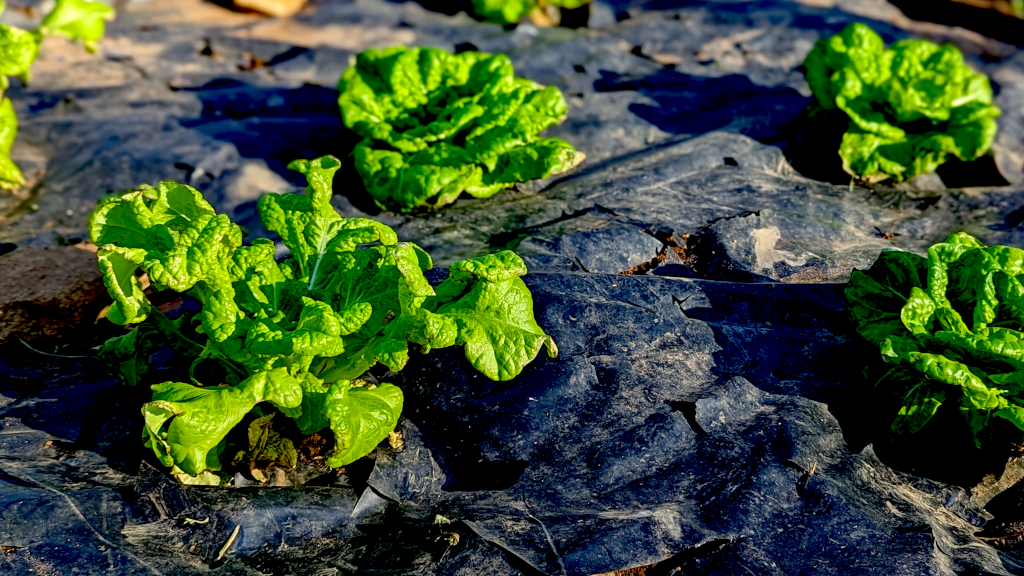
In the banner image at the top of this post, Salad Bowl is the variety in the left foreground, while Winter Density populate the backup chorus behind. They've all been there looking around, gathering sunlight, for several days now, and they seem wonderfully content. Which, in turn, rubs off on me as well.
The ghouls of depression have long tentacles, best kept at bay by a garden in motion.
Lettuce rejoice.