Judgment Fund Day

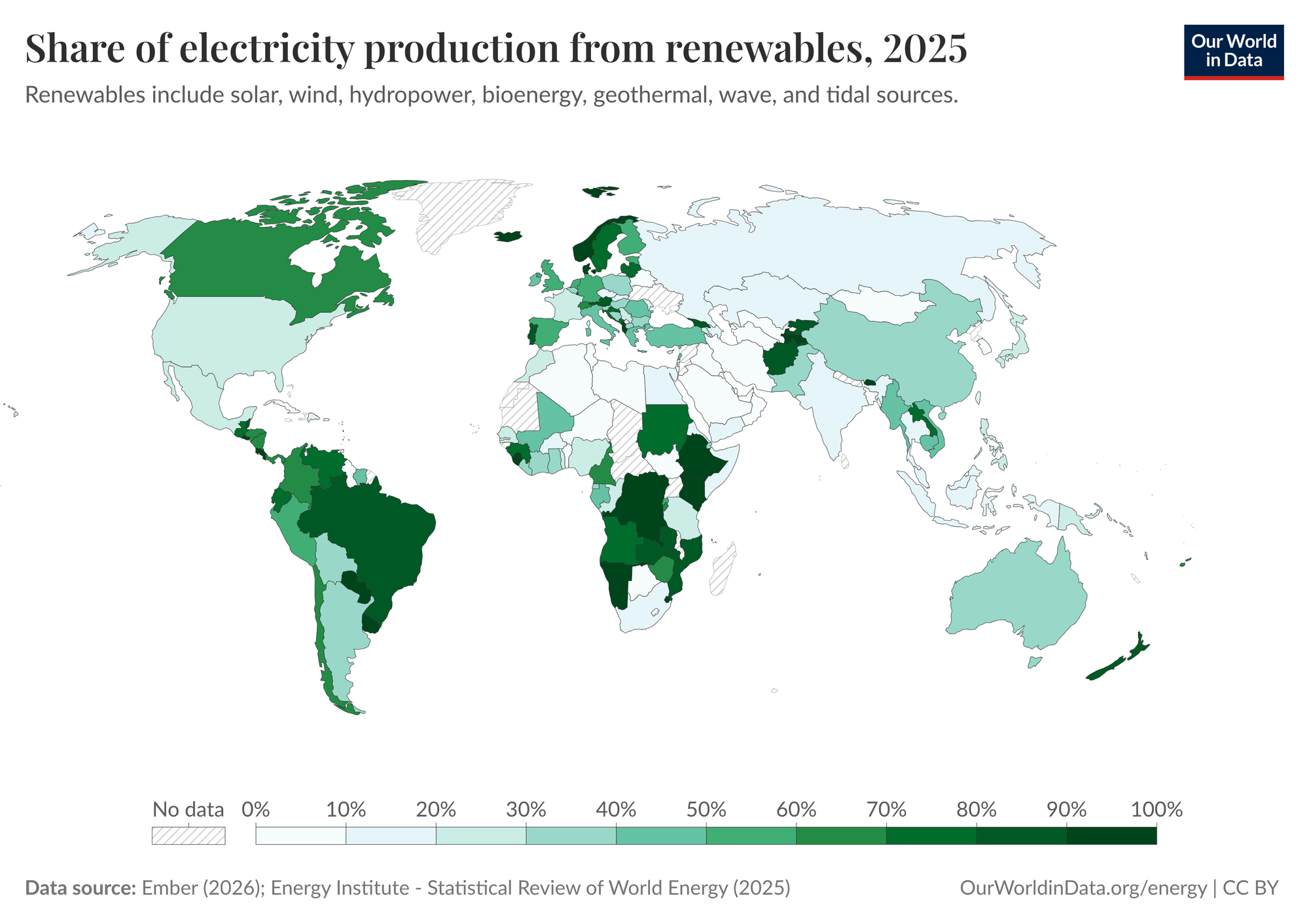
The banner image above is a map, by country, of the fraction of electricity generated by renewable energy sources. If you look in the rear view mirror, the US can be seen receding into the distant past. While the Trump Regime forces us to "Burn, Baby, Burn!" the rest of the world isn't waiting around.
A few weeks ago, I had some fun at Trump's expense recapping his failures at trying to stop offshore wind farms. And indeed, over the course of 2025 and early 2026, Trump failed to stop all five major offshore wind farms that were already under construction. Failed miserably. Chalk one up for our legal system.
But the Trump motto apparently can be summarized as: "If at first you don't destroy it, use a bigger hammer."
If the courts won't allow you to torpedo legal offshore wind energy projects – projects already under construction -- then, obviously, the next best gambit is to prevent any new ones from starting in the first place. How? Just raid the public piggy bank and buy them out. As Ryan Cooper wrote:
… of late [Trump's] administration has come up with an innovative new strategy: bribery. Rather than harassing the French developer TotalEnergies to drop two planned wind farm projects, the administration offered it nearly a billion dollars to not build them.
In early 2022, the energy company Attentive posted a "bonus bid" on an Atlantic offshore wind energy lease, OSC-A 0538, and it won with a bid of $795 million. The Bureau of Ocean Energy Management (BOEM) finalized that bid on May 1, 2022. Attentive is now owned by the French energy company TotalEnergies.
Meanwhile, TotalEnergies made its own "bonus bid" for an offshore wind lease, OSC-A 0545, and it won with a bid of $160 million. But TotalEnergies apparently had an old Monopoly card for a "bidding credit" and ended up securing the bid with the transfer of $133,333,333. BOEM finalized that bid on June 1, 2022.
What is a "bonus bid?" you ask. The website US Law Explained (no substitute for a real lawyer, it notes) explains it this way:
It’s the high-stakes, non-refundable down payment a company makes to the government to win the right to explore for and develop public resources like oil, gas, or coal. The highest bidder wins the lease, securing a potentially lucrative opportunity while providing immediate revenue for the American public.
Note, "non-refundable." The lease holder can't demand its money back if it turns out there is no oil, or gas, or coal, or wind to be found. Also note, "revenue for the American public." That bid money is your bonus.
By June of 2022, then, TotalEnergies had paid BOEM a total of $928,333,333 for offshore wind farm leases in the Atlantic. Rounded to the nearest Trump $250 dollar bill, that's the "billion dollars" you may read about in the news reports of the case.
Then, in November of 2024, the American voters returned Trump to the soon to be half-demolished White House.
In response to Trump's election, TotalEnergies immediately closed up shop on the Attentive lease, pausing development for 4 years. As Offshore reported (2024-11-27):
“I have decided to put the project on pause,” TotalEnergies’ CEO Patrick Pouyanne said at the Energy Intelligence Forum, according to reports from Bloomberg and Reuters.
...
Pouyanne indicated TotalEnergies may wait for political winds to shift again. “I said to my team, the project in New York, we’ll see that in four years,” he said, Bloomberg reported. “But the advantage is it’s only for four years.”
Except, TotalEnergies' patience was about a long as a snake's arm; Pouyanne wasn't about to hang around the street corner for four years twiddling his thumbs. A little over a year after putting Attentive on pause, BOEM agreed to pay back TotalEnergies' for its bonus bid, all billion dollars of it, and TotalEnergies agreed to legally abandon the lease altogether. In short, Trump paid one of the largest wind energy companies in the world a billion dollars to not build wind energy farms anywhere Trump would know where they were.
The history of the American windmill goes back at least 172 years to Ellington, Connecticut, when machinist Daniel Halladay patented the first commercial viable windmill. Called Halladay's Self-Governing Windmill, it could automatically rotate to follow changing winds and trim its sails to operate at constant speed under variable wind conditions. A marvel, all without human intervention. The cost, in 1854, was $50 for the windmill, and another $25 for the pipes and water pump. Adjusted for inflation, that's about $3000 total in today's market. Not a bad deal.
The pitch man behind the business was John Burnham, a pump salesman who realized the retail value added of a machine that could run a water pump without biology; without busting a bicep or a bovine. Or a mule. The two men eventually moved the manufacture and sales of the windmills to Batavia, Illinois, and formed the U.S. Wind Engine & Pump Company. They sold thousands of units to farms and railroads throughout the mid-West and frontier plains and prairies.
The success of U.S. Wind Engine & Pump Company set off a mad scramble, "a sort of 'windmill war' between rival companies." By 1893 the Chicago Worlds Fair mounted a massive exhibit of windmills of all kinds.
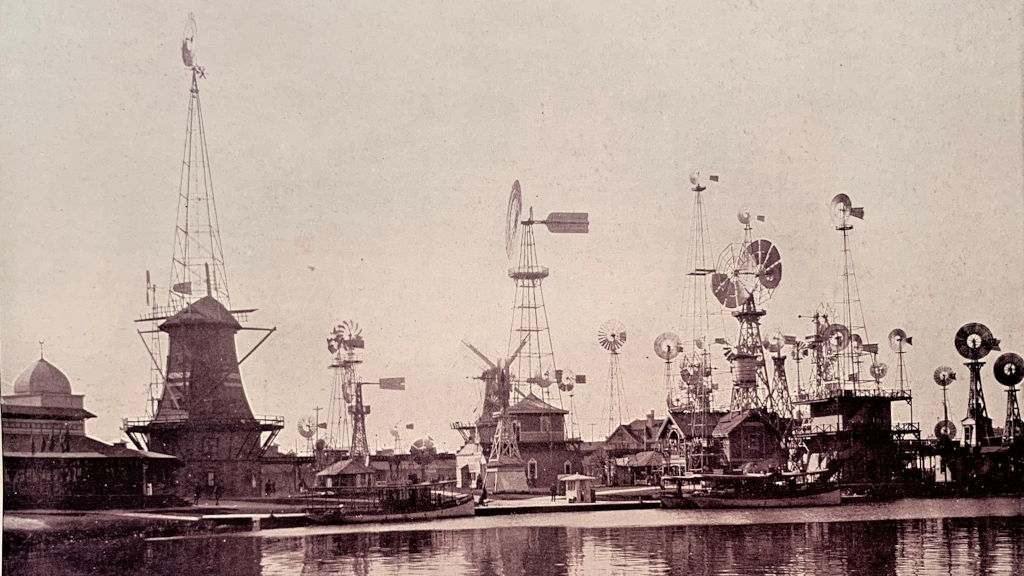

The boom was short lived. By the mid- to late-1940s the industry was essentially gone, pushed off the farms by the Rural Electrification Act of 1936. American manufacturer Aermotor hangs on, providing water pump windmills and parts for Amish farms and specialty installations. But by and large we are down to toy windmills you can buy at Tractor Supply for $129.99 each.
So wait a minute! How does this work? How does the Trump regime get to cancel a lease, pay back the lease-holder, and deprive the U.S. public of our bonus?
The answer is the Judgment Fund. Paul F. Figley, at the American University Washington College of Law, summarizes the fund this way:
The Judgment Fund is the mechanism Congress established to pay most settlements and judgments against the federal government. The Fund, originally created in 1956 and limited then to paying judgments of $100,000 or less, was repeatedly expanded until the current, 1977 version that automatically pays settlements and judgments regardless of amount. It is “a permanent, indefinite appropriation for the satisfaction of judgments, awards, and compromise settlements against the United States.”
The Judgment Fund is the fairy tale magic purse that is always full of money.
The Judgment Fund describes itself this way on its web page:
Federal agencies may ask the Bureau of the Fiscal Service to pay from the Judgment Fund for:
- Most court judgments and Justice Department settlements of actual or imminent litigation against the government
- Administrative claim awards (settlements by agencies at the administrative level, not involving a lawsuit)
So! No litigation required! No courts need be injured in the pilferage! All you need to do is get DOJ to weasel up a settlement and send the invoice over to Treasury.
Here's how it worked in the TotalEnergies case. The settlement for Attentive is here, and for TotalEnergies here. Although they have more "WHEREAS" clauses than a Trump prenuptial, they are not that hard to parse.
BOEM said in the settlements that it was going to suspend the TotalEnergies leases indefinitely because of classified national security issues. The space between the lines reads, "The courts blew up this argument just a few weeks ago and we lost bigly." Then the settlement goes on to stipulate that it is reasonable to assume that TotalEnergies would be expected to sue the government in response. Therefore, to avoid all this nasty business, BOEM (a.k.a. the Judgment Fund) will just settle with TotalEnergies for the amount of its original bonus bids, and TotalEnergies will agree to abandon its leases without causing a fuss.
Now BOEM and TotalEnergies will tell you that TotalEnergies plans to redirect that billion dollars – known as "Eligible Expenditures" in settlement-speak – to investments in "Conventional Energy Projects," defined in the documents broadly as follows:
D. "Conventional Energy Projects" means any investment in (i) oil & gas production, gathering, transportation, processing, storage or refining, (ii) liquefied natural gas, (iii) generation or transmission of non-renewable based electricity (including for the sake of clarity CCGTs), (iv) tank farms and, (v) any related infrastructures to (i) - (iv).
This is legerdemain. You (the American citizen) are supposed to think that you haven't actually lost your bonus bid. That it is simply re-purposed, moved around, applied to warming the planet more rapidly. And clumsy legerdemain at that.
First, sticking TotalEnergies' accepted bribe into private company investments, even if they did that, is quite the opposite of sticking it in the U.S. Treasury for American citizens. Second, BOEM has accepted as Eligible Expenditures investments TotalEnergies had already committed to in the U.S. petrochemical industry before the settlement was even a gleam in BOEM's eye. These were not new investments as a result of the settlement.
You (the American citizen) lost that bonus bid. BOEM gave it away. The Judgment Fund paid it back to the French company on April 23, 2026. All because Trump was frightened by a miniature golf windmill when he was very young.
"Aannnd … it's gone."
You and I both wish I could have wrapped up this essay with that meme from South Park.
I focused on the TotalEnergies dealings here for simplicity. But you have to know that the Trump regime has repeated this game plan with several other energy companies. These include Bluepoint Wind with leases off New York and New Jersey, and Golden State Wind with leases off central California. Maxine Joselow and Brad Plumer have a good write-up in The New York Times.
I don't have enough fingers and toes on which to tally the number of lawsuits being brought over these wind farm buyouts. If previous results are any indication, Trump may have a very, very, bad back nine.
Those of you thinking, "Judgment Fund? Hmm. Judgment Fund. Haven't I heard that somewhere else recently?" Bingo. Todd Blanche played exactly the same game with Trump's "Anti-Weaponization Fund."
First, Trump sued the IRS for $10 billion because his tax data leaked. Oh, the horrors! Then, Trump withdrew his case before the courts could rule on it. (It's bogus. Trump is both plaintive and defendant! "You - can't - doo - that!" The chant fills the arena.) Then, DOJ worked out a "settlement" to this non-existent litigation for $1.776 billion dollars to be distributed through the Judgment Fund. Busy folks over there at the Judgment Fund.
However, U.S. District Judge Leonie Brinkema in Alexandria, Virginia, was apparently in the arena and, on May 29, she said, "You can't do that!" and blocked implementation until she can hold a hearing scheduled for June 12. It may be moot, because ...
The breaking news today is that Blanche told House Appropriations subcommittee members that DOJ is "not moving forward" with the Anti-Weaponization Fund. Cross his heart and hope to die. The IRS, on the other hand, is standing firm on its commitment to drop all pending probes of Trump's dodgy tax status. "Nothing has changed with that," Blanche assured us.
Bottom line: It's Judgment Day for the Judgment Fund. Fix the feakin' Judgment Fund for crying out loud! Paul Figley, American University, has been banging this pan for decades now. At least put a cap on it; it's spewing corruption like a blown out oil rig. Even better, in my layman's opinion, get rid of the "administrative claims award" loophole. DOJ and BOEM shouldn't be able to make up fake settlements. Only legal court judgments should be payable through the Judgment Fund. It's in the name.
Happy Judgment Fund Day, for those who follow.