By the Light of the Silvery Moon

I am not an engineer, let alone an aerospace engineer. The closest I come is a sort of, kinda, genetic engineer, which is very much not the same thing. Any screw-ups in this post are mine and, if you spot any, I welcome corrections.
In the previous post we talked about the company Reflect Orbital, which is applying for a launch permit to send a single satellite into low Earth orbit. The satellite will deploy an 18 meter diameter mirror to reflect sunlight down to the ground as a spot 5-7 km in diameter. Larger 54 m diameter mirrors would follow. Their motto: "Sunlight on Demand."
Here I want to explore truth, silliness and reality.
A chicken in every pot
The Reflect Orbital website claims that they can provide a reflected spot of sunlight anywhere, anytime, for any length of time. Here is their P.R. pitch for the "Defense" customer base (bold is mine):
Reflect Orbital enables continuous solar energy availability by directing sunlight onto terrestrial solar panels and providing on-demand lighting where needed. This technology, known as “Sunlight-as-a-Service”, ensures uninterrupted energy production and lighting with no additional infrastructure required on the ground.
Here's their pitch for the "Response" – search and rescue -- segment (again, bold is mine):
Reflect Orbital’s reflected sunlight solution provides reliable, adjustable lighting at the touch of a button, supporting around-the-clock operations and ensuring your team has the on-call illumination needed—day and night. … Our system provides consistent light when and where it’s needed, enabling your team to search and respond without interruption or advanced planning.
Let's get a one thing straight right away: They can't do this as claimed. Not for anywhere, not for anytime, not for any length of time. These claims don't add up as best I can tell. They are unlikely to even be "future truths."
Ever notice the Earth blocks sunlight?
On the night of March 14 this year, Max and I were out with our camera and telescope, capturing images of a total lunar eclipse. It was an awesome sight, and I hope you saw it too! For hours the Earth blocked sunlight from reaching the Moon, plunging it into a blood red darkness, illuminated only by pale rose-colored light scattered from our atmosphere. During that time even a gigantic mirror on the Moon itself would have found no useful sunlight to reflect. And the Moon is some 285,000 miles away.
For a tiny 18 m diameter mirror hanging around at 600 km above the Earth, the eclipse is total nearly all night long. At 600 km above Joe-Random-Spot-on-Earth, at midnight, there is no sunlight to reflect. You can press all the app buttons you want, summon all the mirrors in the World to assemble overhead, and you have zero chance of illumination, ambient or otherwise.
Sailing a fine line
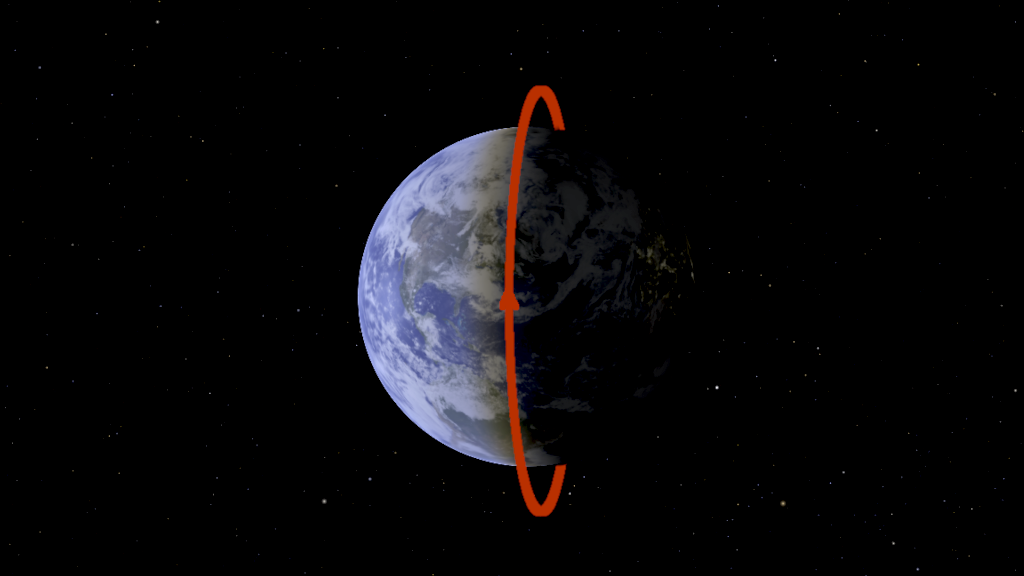
There is only one location where Reflect Orbital's mirrors will be able to see both the Sun, at one angle, and darkness at another, and that is along the "terminator," the zone between day and night. As shown in the banner picture at the top of this post, Reflect Orbital's satellites must orbit along the red-line path, pole-to-pole orbits fixed with respect to the sun.
Imagine spinning only the Earth in that image: the Earth will rotate, but the red line will not, and the orbit will always be aligned along the day-night divide. By collecting sunlight from the bright side of the terminator and reflecting it off into the dark side, a fleet of satellites could, in theory, extend daylight up to about 2 hours on one side of the Earth, and similarly initiate daylight about 2 hours earlier on the other.
That's it.
If Sasquatch pops an Achilles tendon on Mt. Denali McKinley Denali one evening, he and his rescue team will find the mountain has rotated away from the terminator, and beyond the reach of Reflect Orbital's flashlight, within a couple of hours after sundown. And it won't come into sight again until a couple hours before sunrise.
One to two hours of extra search time in the morning and evening is not nothing, depending on the circumstances. But it is not everything. It is not the "on-call illumination needed—day and night" claimed by Reflect Orbital.
Numbers go up
Even this takes a lot of satellites. The 5-7 km spot on earth reflected from an orbiting satellite is traveling some 18,000 mph, and spends only about 0.5 seconds passing through any one location on Earth. Not very useful.
That service can be extended to approximately 4 min if the satellite engages its target some distance ahead, and keeps pointing at it, passes by, and keeps pointing until the target falls some distance in the rear. Then a second hypothetical satellite coming up from behind can take over for another 4 min duty cycle. If these 4 min targets are roughly 2000 km apart, Reflect Orbital can service 20 of these sites with a maximally sparse deployment of satellites.
However, with this minimal configuration, customers would be in local exclusive-use competition. Meaning, if Reflect Orbital were illuminating a solar farm near Richmond, Virginia, it could not simultaneously provide illumination to a separate solar farm in Petersburg. Again, not very useful.
And so Reflect is proposing a constellation of 4000 satellites by 2030. Ultimately, that will need to grow to perhaps 250,000.
Sure thing.
Reality bites
Can't we simply relay the sunlight from satellite to satellite deep into the midnight sky, and then down to Earth? You've got 250,000 of them after all. Well, no. Unfortunately, the reflected beam spreads. That's just physics. The beam from the first 54 m mirror (in functional deployment) spreads out, so when it reaches the second 54 m mirror only a fraction of the sunlight is captured. These losses compound on each relay.
Well, then, can't we focus or collimate the light so it can be relayed efficiently? Well, I suppose. Theoretically. You might install giant Fresnel lens with a focal length of 600 km. But now you are just being silly. Bouncing thousands of focused Star Wars light sabers around the night sky from satellite to satellite? That sounds like a great idea! What could possibly go wrong!
Bottom line? Despite their P.R., for now and likely forever, Reflect Orbital can't deliver sunlight to a specific location, on demand, 24/7.
But wait! This company just got well over $20 million in venture capital and government grants. So what can they do? There must be something. If only just a little? My guess, up next.
Correction 2025-12-04. Reflect Orbital's larger mirrors for production deployment are planned to be 54 meters, not 57 meters as originally stated here. The post has been updated.