Bifurcations

Two roads diverged in a yellow wood,
And sorry I could not travel both
And be one traveler
-- Robert Frost, The Road Not Taken
A bifurcation is the point at which a dynamic system undergoes an irreversible division into two separate pathways with qualitatively different behaviors. It results from small incremental changes to parameters, which eventually produce a sudden change in form. In that sense, bifurcation is related to the environmental tipping points we've looked at before.
Max and I were imaging IC 405, the Flaming Star Nebula, with a stop on the exoplanet Aesopsfaira.
"Bifurcation theory predicts," said Adin, "that another Aesopsfaira exists on the other branch of the environmental collapse."
As he explained it, Aesopsfaira was once a stable, peaceful ecosystem, at balance and in equilibrium. Evolving, but in time with the stars. It was a world of science, libraries, theater, and grand paintings and sculpture. Technological advances, like the glass lens, opened new vistas to those stars.
Then, gradually, greed captured a clutch of Aesopins. For them, fabulous wealth could be had by controlling the production and distribution of energy resources. At first, the advantages were just convenience; fossil fuels were more concentrated and more localized. Rather than foraging the far forests for fire wood, companies could simply send miners into the ground at one spot for generations. An entire winter's energy supply could be purchased from a delivery van and dumped down a chute into the basement.
This concentration then facilitated scale. Factory furnaces could burn more fiercely. Electricity could be produced anywhere, not just at fall lines along the rivers. The quantity of fossil fuels was unlimited. And when it was accepted that it was not unlimited, scientific minds set to the task of cracking open the ground to find more. Convenience led to, and locked in, dependence. Dependence led to profits, which led to oligarch monopoly. And more profits.
"Looking to where it bent in the undergrowth," that small incremental increase in greenhouse gases, as parameter values, pointed to an imminent bifurcation. There was a choice, once: Continue fossil fuel pollution enriching the rich, or transition to renewable energy and avoid the bifurcation. Greed, in league with breathtaking myopia, chose profits. It chose environmental collapse.
The raging wildfires were closing in. Even on the glass ballroom of the oligarchs, on the rich and powerful. But they lived, and dined, and danced in air-conditioned splendor, gilt gold appointments throughout, chilled to a mildly uncomfortable temperature for those exposed in daring cleavage gowns. In splendor they danced, oblivious to the road they chose.
Aesopins now faced the raw conclusion that there was no longer any future on their Aesopsfaira. Food and water were nearly gone, not to return with a new season no different from the current, or worse. Outside of billionaire enclaves, the environment was intolerable. They faced only extinction.
And so they gathered across the plateau, in formation, waiting to sail to the Bifurcation, the name given to the Aesopsfaira world across the divide.
I was lost. "I don't understand. A parallel universe?"
"Not a parallel universe, exactly," said Max. "Rather an alternative existence. Think of it like the square root of minus one. A reality for calculation but an "imaginary" number, for lack of a better term. This Aesopsfaira, the one we are standing on, exists in one branch of a bifurcation. Therefore, there should be another existing in the other branch. In theory."
"But how will you find it?"
"In theory," said Adin, "AE Aurigae will take us there."
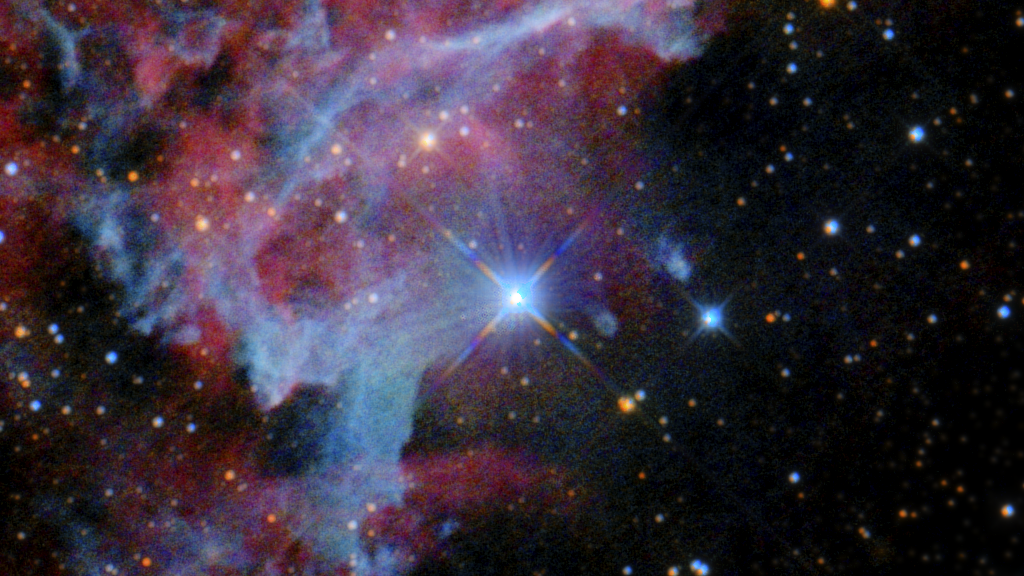
AE Aurigae, the bright central star in the banner image up top, doesn't belong there. I mean, it wasn't born in the molecular cloud that is IC 405. It is "from away." AE Aurigae is what's known as a "runaway" star.
We tend to think of the stars as being static, fixed in place. After all, the constellations look the same night after night. But in reality the stars are all moving, reacting to gravitational forces, if no more than to hold their own in an expanding universe. But compared to most other stars, AE Aurigae is burning rubber!
But how do you measure the speed of a star, anyway?
It is seriously non-trivial. Basically, you need to know the star's distance, how fast it is arcing across the sky (called "proper motion"), and how fast it is coming toward us, or going away from us (called "radial velocity"). With those parameters one has the trig to calculate its relative motion in space.
The easiest parameter to measure is "radial velocity." Thanks to Doppler. As a star speeds towards us, or away from us, its light is shifted to shorter wavelengths, a blueshift, or longer wavelengths, a redshift. Current instrumentation is quite sensitive to these shifts and so radial velocity can be estimated accurately. Right now.
Proper motion is a little harder. It takes time. Basically, the job is to compare the positions of stars from measurements taken years apart. The English astronomer Edmond Halley first noted that several notable stars, like Sirius, had shifted a half a degree from their positions recorded by Chinese astronomers almost 2000 years earlier. Today, computers have taken all the fun out of it. Proper motions are determined by computers using comparative imaging of star survey data sets.
Distance is the hard one; how far away is that star? Well, I don't know. Ah. Sounds like you need some Parallax! Parallax is the trick of looking with one eye and then the other to make a close object shift relative to background objects. You can do it with your cell phone right now. The distance to your cell phone can be determined from that angle of shift.
For stellar objects, of course, our eyes aren't far enough apart. Instead, one can use a telescope to image a star when the Earth is on one side of the Sun, and then do it again six months later when the Earth is on the other side of the Sun. In the two views, nearby stars shift their apparent positions relative to very distant stars, and Bingo! Solar parallax. Las Cumbres Observatory has a very nice web page on using parallax to measure stellar distances.
That is a long-winded preface to say that AE Aurigae is speeding its way through the Milky Way at approximately 150 kilometers per second. That's 336 thousand miles per hour for the imperialists among us. For context, our Sun is wandering about, exploring its place in the galaxy, at roughly 7 km/sec. Most of our neighboring stars are out for leisurely walks of around 30 km/sec or less. And a few adventurous youngsters are blasting away at 200 to 250 km/sec, destined to escape the galaxy altogether for parts unknown. Clearly AE Aurigae is laying tracks, which raises the interesting question: where did it begin?
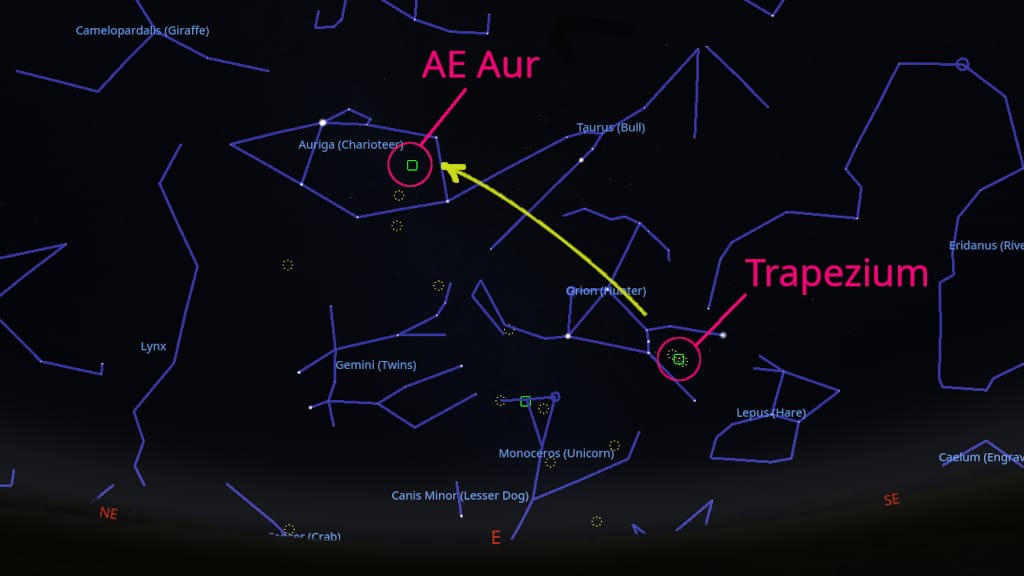
By tracing AE Aurigae's current trajectory backwards over the course of its 2 million year lifespan, it is thought to have originated in the region now occupied by the Trapezium in the constellation Orion. That itinerary takes it on a 60° arc across the sky. Here's a look at its amazing journey:
The coolest part is that AE Aurigae is moving so fast through the molecular cloud of IC 405 that it creates a "bow shock" in the cloud, a dynamic compression wave as it pushes its way through. The concept is like a boat creating a wave at its bow and a wake behind as it moves through the water.
A bow shock wave begging to be surfed by wandering Aesopins.
The details of climate collapse are complicated.
No one really took notice of the insurance industry, save for the insurance industry itself, and it dared not make too big a deal of it for fear of government retaliation and regulation. The wrath of the Emperor King, in some 2 AM post on Solar Social, could tank dividends for an entire quarter.
But there were already large areas on the planet that were uninsurable. No water and frequent fires. Or a deluge of water and mud slides of destruction. Large areas where policies were being canceled at the time of renewal, if they were ever written in the first place.
The insurance industry thought they had banked on the risk of global warming, but they hadn't sufficiently listened to their own environmental experts. Experts that were routinely bashed by the Extraction Industries Sector. Insurers were way over-exposed, with not enough assets to cover liabilities should a major fire take out everything.
Yet most commerce, almost anything, anywhere on Aesopsfaira, depended on insurance, like it or not. Mortgage insurance, life insurance, commodity insurance. No insurance? Sorry, no mortgage. No mortgage? Sorry, no lending for anything from Granny's bungalow to Meeda's Mega Data Centers. Lending collapse? Sorry, you're bankrupt, your Mega Data Center is now worth nothing. Have a nice day.
"Are you ready, Max?" Adin scanned the landscape, as if watching for something.
"Ready," replied Max.
He pulled a Pegasus AI LLM RoboBot out of its case and connected it up to the local WiFi network.
"Are they paying attention, Adin?" he asked.
"Yes, of course, they're paying attention! Well, I mean, no the 1% aren't listening personally. They're too busy at the Gala Ball right now. But their minions are certainly watching closely. Hell, they're paying $100,000 per month for the privilege of getting priority access to his drivel. They're not about to let some possible tip go by accidentally."
"Okay. Here we go. Wish us luck."
Max booted the Pegasus and typed in the prompt:
"Pegasus, please announce the bankruptcy of Floyd's, KQ Forgin, and The Indelible Insurance companies. Bankruptcy due to wildfires, flooding, wind damage, and irreversible climate change. Write in the style of the Emperor King, and post it on the Solar Social API as soon as possible."
Pegasus buzzed for a few seconds, before registering "Complete."
"Okay, now what?" I asked.
In a couple of minutes, a murmur began spreading through the assembled Aesopins.
"They're selling? They're really selling?"
Screen devices were passed from hand to hand.
"Whoa!, They're actually dumping everything! Numbers go down!"
"Good Lord, it's programmed bot trading! The whole thing is crashing!"
Max and Adin exchanged looks. Looks exposing something of relief.
Max turned back to the Pegasus bot box.
"Pegasus, please buy equity and banking securities on behalf of Aesopin Futures, LLC. at parabola minimum, optimized up to technical limit."
"Complete."
The sound of horns reverberated out across the plateau, cascading down into the valley, up into the distant mountains, and back again. Lost parallels of Aaron Copeland's Overture for the Common Man, perhaps. It repeated over a three note sequence, in two tone fifths; something like F4-C5, rising to Ab4-Eb5, lingering, and back again. Ambiguously minor. Full of choral overtones.
It was the sign.
I watched as the vast assembly of Aesopins embraced, said their goodbyes to one another, and climbed into their bootleg genAI robot-made spaceships, elevating slightly off the ground in preparation for departure.
"Good bye, Max."
"God speed, Adin."
"Indeed."
Just as the horns resolved upward to their final call, a sustained tonic G4-E5, the entire formation lifted as one and flew out over the valley. Each spaceship was unique, designed and produced by its own free spirit, and each accelerated at its own propulsive frequency. Together, the swarm produced the universal rush of white noise, the stuff of dreams, washing away the lingering reverb of the clarions.
The smoke cleared briefly, whisked away by the wind, letting sunshine light the way. As the ships crossed the valley, they banked and flew low over the city. Flames were consuming everything, even licking at the foundation of the glass ballroom. Wheeling one last time, the formation turned, and rushed away toward the night horizon. And AE Aurigae.
The ballroom shattered. Its glass unable to withstand any longer the stress of the cold interior against the burning exterior. It gave out the sound of a thousand cracks splitting old ice on a frozen lake. Shards of glass flew across the valley to mark its lost domain. The building sighed, and then collapsed, disappearing into a cloud of smoke and debris.
In the morning I went out to take down the telescope. The dried grass crunched underfoot. I picked up a loose piece of a broken soft drink bottle carelessly discarded by the side of the lane. Disconnecting all the power cables and electronics, I folded up the tripod and scope, and packed everything back indoors for coffee.
As I feared, smoke had crept in overnight, decreasing transparency. The majority of the images in that session would need to be discarded.
"That was an awesome story, Max!"
"Mmm."
"But … well, we don't have a second Earth do we? An Earth on another branch of a bifurcation to which we can self-deport."
"I don't know," said Max. "There are some who believe that Earth hasn't yet passed its environmental bifurcation. That there is still time to choose the pathway with a future for life on Earth."
"Good luck with that." I said. "We've turned everything over to the Extraction Industries Sector billionaires and their toadies. We can't even give away an offshore wind farm."
"I like to side with the optimists anyway," said Max. "But it's going to take a lot of work, unity, and conviction among what is probably a majority to pull it off. No doubt about that."
"Sometimes I get really depressed, Max. A feeling of uselessness. What could possibly make any difference."
"Well," he said, "you can write."
"I am inordinately proud these days of the quill, for it has shown itself, historically, to be the hypodermic that inoculates men and keeps the germ of freedom always in circulation, so that there are individuals in every time in every land who are the carriers, the Typhoid Marys, capable of infecting others by mere contact and example. These persons are feared by every tyrant--who shows his fear by burning the books and destroying the individuals. A writer goes about his task today with the extra satisfaction the comes from knowing that he will be the first to have his head lopped off--even before the political dandies."
-- E. B. White, Freedom, July 1940, from One Man's Meat