At the Circus

“If you can come up with something that [rich people will] regard as special, you can really make a lot of money selling to them,” said Robert Frank, a professor of management and economics at Cornell. “So, a lot of the ingenuity in the economy gets directed to things that we would think of as less than essential.”
– Emma Janssen in The American Prospect
In part 1 of this series, we explored a little of the history of space-based solar reflection and introduced Reflect Orbital Inc, a startup company seeking to put it into practice. In part 2, we looked at what Reflect Orbital actually intends to do, and poked some fun at their silly P.R. over-hyped exaggeration.
Here I want to continue with a little silliness, look at what we might expect from Reflect Orbital, what might work – and what probably won't.
Commoditize sunlight
The primary objective of Reflect Orbital, its first pitch, is/was to sell extra hours of sunlight specifically to photovoltaic solar panel farms so that they can produce electricity when the Sun itself is in hiding.
"By precisely reflecting sunlight that is endlessly available in space to specific targets on the ground, we can create a world where sunlight powers solar farms for longer than just daytime, and in doing this, commoditize sunlight."
– Ben Nowack CEO Reflect Orbital
The song goes: paying for mirrors in space for extra generation time is more cost effective than buying batteries, or other storage technologies.
It must be said that some well respected aerospace engineers have examined the economics of satellite-based solar reflection and concluded that it is feasible and theoretically economical. Colin McInnis, current Chair of Engineering Science at Glasgow University is one. In a paper in the journal Applied Energy (2022), Oderinwale and McInnes compare the economics of orbiting solar reflectors (OSR) against standard storage practice, and they conclude:
The obtained results demonstrate that irrespective of the market conditions, the solar farm receives better economic value when integrated with OSR.
And they are currently working on technology up the same alley as that of Reflect Orbital with a €2.5 million ERC Advanced Grant for five years of research.
As far back as 1977, the late Kenneth Billman, while at Ames Research Center, was a pioneering advocate for the technology as a theoretical cost-effective addition to terrestrial energy generation. Billman et al. conclude:
The use of orbiting mirrors for providing energy to ground conversion stations to produce electrical power is shown to be a viable, cost effective and environmentally sound alternative to satellite solar power stations and conventional power sources.
With that caveat, the Reflect Orbital model, as presented so far, just doesn't add up. Michael J. I. Brown (Monash University) and Matthew Kenworthy (Leiden University), writing in The Conversation calculate that even with the 54 meter size mirror, Reflect Orbital will need 3,000 of them all focused on the same location to generate 20% of the energy produced by the Sun. Ethan Siegel, writing at Starts with a Bang, and Dave Johns, at EEVblog, have both run the numbers and come to similar conclusions. Siegel writes:
… you’d need thousands of these satellites working together to produce any sort of meaningful power: about 5000 of the 54-meter variety and about 50,000 of the 18-meter variety.
Worse, that one constellation of thousands of orbiting satellites can only point at that one power-plant for the 4 min slot of time before they are out of range. And then you must call in another constellation of thousands more to take over.
So, it would seem, Reflect Orbital is going to need multiple constellations of multiple mirrors if it intends to supplement terrestrial solar power production.
Billman et al., back in 1977, are in complete agreement. Here is the timeline they proposed for a deployment scheme to ultimately provide 100% of the world's electricity needs:
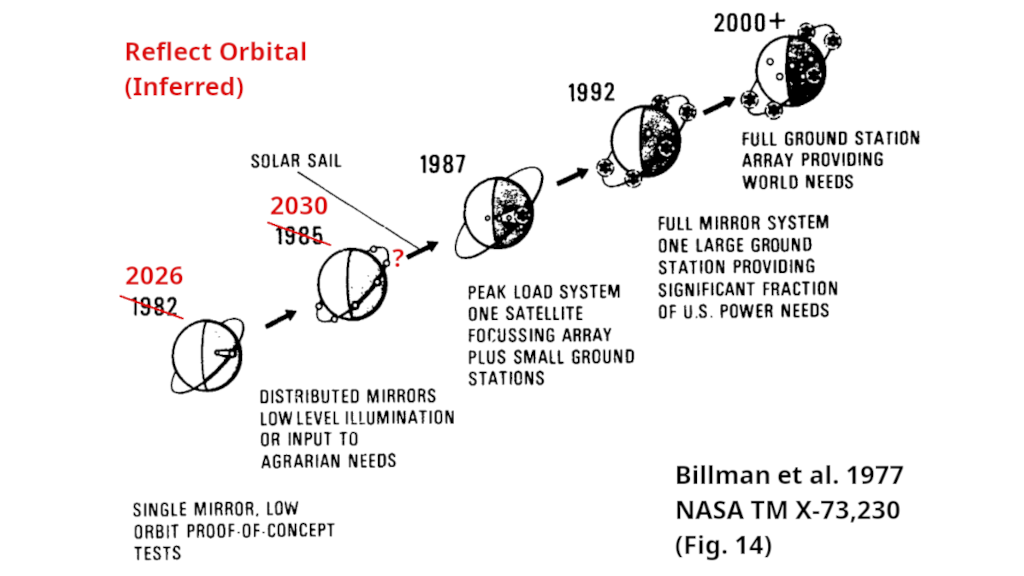
I have overlaid the Reflect Orbital timeline as best I can infer from their website and videos. Their launch license application for a single satellite reflector is equivalent to the first step of Billman et al. and the future, ill-defined, 4000 satellite distributed array corresponds pretty well with the second.
You can't generate PV electricity from moonlight
Reflect Orbital often wax poetic about the soft quality of their sunlight on demand.
Move beyond concentrated street lighting with a more dispersed, softer form of illumination that enhances visibility without the energy-intensive spotlight effect.
Just like moonlight, more or less. The light from one of their mirrors is often compared to moonlight, or some integer multiple of moonlight.
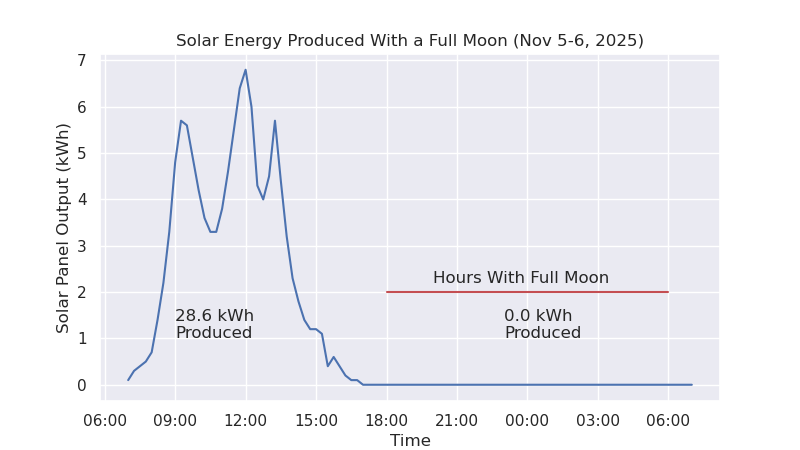
There was a full moon the night of November 5 this year. The skies were clear and I set up the telescope to image the Cave Nebula, IC 342, which was on the opposite side of the sky from the Moon. Our solar panels were ticking away 24/7 that day and I checked their output. The record is up there in the banner graph on this post.
In November, sunlight at our latitude is already being valiant just to give any warmth at all. So 28.6 kWh, I thought, was a pretty respectable production. How about with a full moon? As you can see in the graph, and to the surprise of absolutely nobody, there were zero kilowatt hours of electricity produced under the full moon. Bummer. Maybe we could order 5000 more moons?
Okay, I'm being silly. You were forewarned. Then again …
War! What is it good for?
Apparently, it is good for buying sunlight. As I noted in the first post in this series, the Air Force awarded Reflect Orbital a Phase II SBIR grant for $1.25 million, which typically last for two years, and these grants are designed to help bring innovative ideas to commercial reality. The title of this award (#F2D-15753), "Satellite Technology Delivering On-Demand Lighting for Military Operations and Uninterrupted Solar Power for Energy Production," suggests that the Air Force buys into this "Sunlight-as-a-Service" pitch. Which is passing strange.
Lighting military operations at night?
The Air Force prides itself on night operations:
“When the sun goes down, we are even stealthier and more difficult to detect by our adversaries," said Maj. Martin Smith, 58th Fighter Squadron F-35A Lightning II instructor pilot.
Companies like Lockheed Martin already provide sophisticated night vision instrumentation:
Night flight operations are a force multiplier, allowing warfighters to harness the cover of darkness for strategic advantage. ... Advanced fighter aircraft like the F-35, F-22 and F-16 don’t just operate at night—they own it. These fighters are built for stealth, equipped with state-of-the-art sensors, radar, and infrared systems that turn darkness into an advantage.
It would seem strange to want to illuminate the theater of operations with sunlight on demand and give up that advantage. Perhaps a little soft light, something close to moonlight, would actually make all this night vision craft work better without aiding the enemy. I don't know.
Perhaps the intent is to specifically illuminate just the base facility in order to provide light for maintenance, repair, and provisioning activities. Well and good, but using thousands of orbiting satellites beaming "We Are Here," all pointing directly to ground operations, might not be the best tactical choice? I don't know.
Solar power production?
The military is clearly working to implement mobile microgrid electrical services to support tactical operations. Supplementing these with orbiting reflected sunlight for power generation has obvious attractions. The more sunlight for solar generation, the less battery storage needed, the lower operational weight, the more mobility on the ground. However, a flock of mirrors, big bright Mylar films, flying predictably pole-to-pole in low earth orbit? Those would seem to pose the perfect targets for anti-satellite weapons. Major Megawatt might suddenly face the realization that his unit didn't bring enough triple A's to run the comm center after all. I don't know.
It is easy to forget that $1.25 million is essentially couch-cushion change for the Department of Defense War. So, maybe the brass are just being silly. However, space warfare isn't exactly becoming any less likely these days. Quite the opposite. And there are a lot of engineering issues in deploying, arranging, aiming, and maneuvering satellite constellations. The Air Force might not care a twit about "Sunlight on Demand," but be perfectly happy to chip in it's rounding error funding for research useful in space operations, and for which the main risk is being borne by private venture capitalists. I don't know.
So what can you do with moonlight?
For all that, and all that, I doubt that Reflect Orbital seriously expects to be powering solar farms, even military solar farms, any time soon. They may have gone in with that intent, but I bet they have (re-)crunched the numbers and understand that solar farms are an impossible long-shot client.
I'm also tossing out the agriculture segment for now. The mirror aficionados seems to treat more hours of reflected moonlight-intensity illumination as if it were just like more hours of direct sunlight. Only fainter. The effect on plants and circadian rhythms is not the same. The literature is a mess – a little serious science polluted by tons of "moonlight gardening" mythology. At this point, as far as we know, sustained increases of moonlight-intensity reflected sunlight is just as likely to confuse the plants as to help them grow. So, a definite maybe.
Now, general moonlight-level illumination might be useful, in theory, if you can put up with the warts of flashing satellite trains beating a sidereal rut across the sky. As Reflect Orbital notes on their website:
"Mining and construction projects shouldn’t stop when the sun goes down. Reflect Orbital’s reflected sunlight solution delivers powerful, continuous illumination to large industrial worksites in remote or infrastructure-limited areas, helping you extend working hours, enhance visibility, and improve worker safety, without the emissions or costs of traditional lighting."
I'm not sure about the "powerful" part but, I ask, "Need to drill for oil in the protected North Slope of Alaska? In a hurry? We've got just the thing!"
Which brings me to where I speculate Reflect Orbital might really be heading, at least in the short term.
You can really make a lot of money selling to rich people
I was surprised to discover that the first market segment you come to on the Reflect Orbital website is labeled "Experience." It is described this way:
Reflect Orbital's innovative lighting solutions are transforming experiential environments—such as entertainment venues, corporate events, and urban public spaces—by providing customizable, high-quality illumination on demand. … Designed for event planners, leading brands and visionaries aiming to introduce a novel touch to their promotions, our scheduled light displays present a contemporary alternative or complement to traditional lighting and entertainment. Deliver a truly memorable experience for your audience with a scheduled spot.
Yes, the present tense used in these blurbs is infuriating; Reflect Orbital's vaporware "solutions" aren't transforming anything. But maybe they could. Maybe these claims could actually be "future truths."
According to Forbes, in this the year of our Lord 2025, there are 3,028 billionaires in the world. That should be enough to fund a distributed mirror constellation of 3,028 satellites. Essentially phase II, in our timeline diagram back up there. If you can rent the city of Venice for your wedding, you're not going to blink at a couple of launch fees! "Light up the venue for your sweetheart, for 15 minutes, with artificial moonlight from high overhead! It's the latest thing, and only the discerning (rich) few can get in on it!"
Here is Reflect Orbital's press release announcing their Series A VC funding:
"Reflect’s first satellite will launch as early as Spring 2026, beginning with its limited “World Tour” lighting experiences in 10 iconic locations. … Reflect is actively contracting with customers after receiving over 260,000 applications for satellite-reflected sunlight from 157 countries last fall."
P.T. Barnum would just die, again, if he could. Reflect Orbital will reflect sunlight to moonlight-illuminate Mt Rushmore, the Egyptian Pyramids, the Taj Mahal, and Mar-a-Lago (they don't list the 10 "iconic locations" – I'm winging it here) for 4 min each, on every new Moon weekend until morale improves, and then sit back and collect reservations through Eventbrite. And wait for SpaceX to buy them out at an exorbitant markup, on the negligible chance that Reflect might threaten Tesla's battery storage market.
Brilliant. Or at least 1/5000 of brilliant.
Okay, so some of this is pretty silly. Why does it matter? Why raise a fuss about a bunch of VC fat cats being taken for a ride? They expect it. They deserve it.
In the lead post, I wrote, "Because if it isn't silliness, it's a nightmare." That's up next.