An Epic Clash of Epochs

Our destination wasn't listed anywhere in the deep space catalogs.
That was the interesting thing. At least, that was the interesting thing for me. Up until now, we just needed to type the name of some deep space object, like "Andromeda Galaxy," and its coordinates would populate the flight plan automatically. Away we'd go.
Not this time. This time we were headed for a grassy knoll in the middle of nowhere. A nowhere, to be sure, but from which you can capture brilliant views of multiple galaxies. But there are no catalog entries for "Nowhere," for "Some cool location in between M84 and M86." Ask like that and you just get unhelpful blank widgets in return.
There are magnificent galaxy clusters out there, prime destinations just waiting for the non-Hubble space traveler to come take a group selfie. And this is just the time of year for it, a time buoyantly known as "Galaxy Season." Apparently, favorable conditions for the formation of one galaxy in Mother Universe often provided good conditions for the formation of many galaxies. Clusters of galaxies. Sort of like coffee shops; if a downtown area is good for one coffee shop, then inevitably there will be a Starbucks on nearly every street corner.
One of those galaxy clusters is known as the Virgo Cluster, and it comes around in early Spring to dazzle those of us tired of cold, damp, cloudy, depressing politics. The Virgo Cluster sports around 1,300 galaxies, all floating in and around the constellation of Virgo. In early March, Virgo is rising in the East around midnight, and its galaxies are suspended well up in the sky, around 50o elevation above the horizon.
Max and I were headed for that grassy knoll in and among the Virgo Cluster that would let us frame M84, M86, and their galactic neighbors.
And since our destinations was sans catalogue, I copied the coordinates between M84 and M86 and entered them into the flight plan by hand.
"It's a Pegasus AI LLM RoboBot," said Max, "but we just call it 'DragonBot'."
Secretary Mars Hogspizz was intrigued.
"And it is trained with an unbeatable warrior ethos," added Max. "No nonsense, no stupid rules of engagement, no woke sissy crap. Would you like to see a demo."
"What, here?" asked Hogspizz.
"Sure!" said Max. "What's your objective?"
"Well," said the Secretary, "We've been using speedster spaceships in the Gulf of Virgo as target practice. Officially we claim they are narcoterrorists running drugs, but they're really just schleps we blow out of the galaxy to condition the troops to civilian atrocities."
"OK," said Max. "DragonBot! Write me a war plan for obliterating a tourist site-seeing spacecraft that has intruded into the Virgo Cluster domain."
"Certainly," burped DragonBot. "I recommend a cross-fire displacement. It is one of the most famous military maneuvers from the earliest days of the galaxies, when Hannibal crossed the Delaware. No one knows this better than our powerful lethality Secretary Hogspizz."
"Hmm," thought Hogspizz, "So true."
"You should place a starship battle group to the East of the tourist, sorry, terrorist spacecraft, while Secretary Hogspizz should command a second battle group to the North. At t=0, the Secretary should lead with a lethal arsenal blast to take out the terrorist (and claim the Medal of Bravery for first strike), then the East battle group should engage what is left and vaporize the remains. No prisoners."
Hogspizz was impressed. "No quarter!" was just what he liked to hear.
"It goes something like this," intoned the DragonBot. "Gunners! Lock your coordinates!"
"Coordinates locked," came the multitimbral reply from the firing bay.
"Who's your Daddy?" shouted the DragonBot.
A moment of confusion followed. Hogspizz squirmed in his chair.
"Who's your Daddy? screamed the DragonBot.
"You are?" came the tentative response.
"WHO???" screamed the DragonBot again.
"You are, Daddy!" came the response this time.
"DADDY WHO??? screamed the DragonBot.
"You are, Daddy DragonBot!" the scream came back.
"Excellent!" shouted the DragonBot. "Now drop and give me 20."
And everyone on the firing bay was down doing 20 push-ups.
"Shit!" said Secretary Hogspizz. "Sold! We'll take a double gross of them."
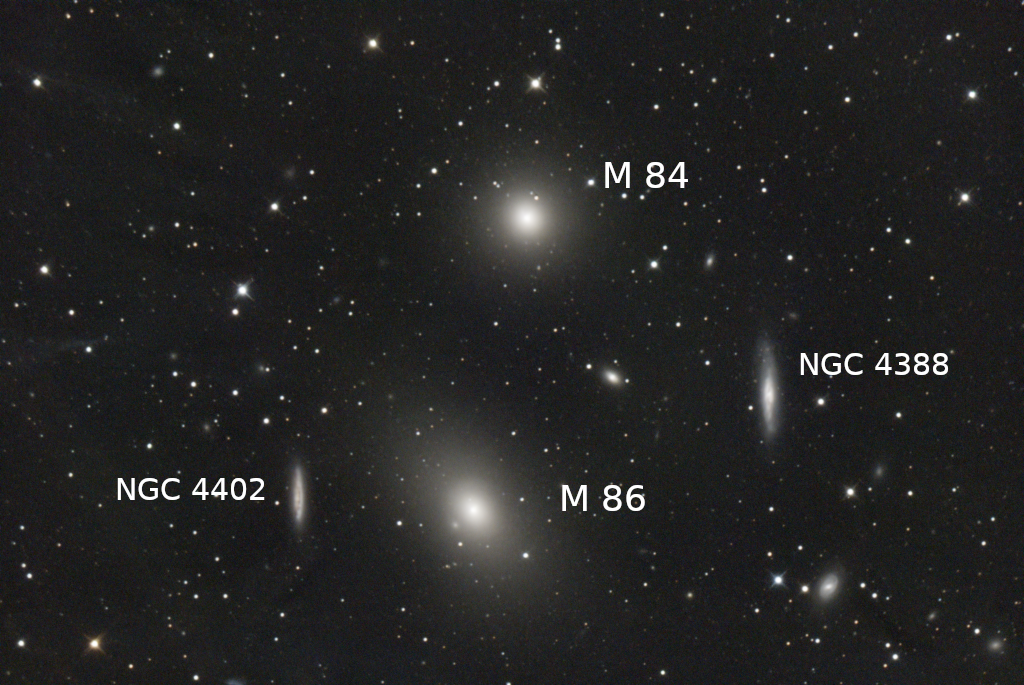
On the first night of our journey to the Virgo Cluster, we sailed out around 50 million light years and pulled up at the edge of a star field. I had entered a set of coordinates that were midway between M84 and M86 so that both would be in the field of view. This worked great, and we took in a marvelous view of multiple galaxies, captured in the image above.
The two prominent "cotton ball" galaxies are M84 (upper) and M86 (lower). They are roughly 110,000 and 135,000 light years in diameter respectively. Both a little bigger than our Milky Way. There are also two smaller edge-on galaxies visible in the image, one on each side, known as NGC 4402 (to the left) and NGC 4388 (to the right). And then numerous additional galaxies, even smaller, dot the field of view.
"Stunning, aren't they!" said Max. "So different from the spiral grand design galaxies."
"Ethereal, for sure," I replied. And I felt the tension in my shoulders dissipate. A little.
M84 and M86 are classified as giant lenticular galaxies. Or perhaps ellipsoidal galaxies. With just one point of view from Earth, it is difficult to tell whether M84 and M86 are shaped like a normal rugby ball, the ellipsoidal class, or if they are disk shaped like a flattened rugby ball that we are seeing face-on, the lenticular class. Most sources keep both possibilities open with a liberal use of the "or" conjunction.
Ellipsoidal galaxies are largely composed of older stars and they are depleted of the interstellar gases needed for new star formation. Despite its soft cotton-candy appearance, M84 has a supermassive black hole sitting at its core, actively spewing jets of X-ray beams out each pole. It has also produced four supernova explosions since 1957.
"Don't look at me! I had nothing to do with those!" said Max.
M86 is similar to M84 but richer in globular star clusters, with some 3,000 scattered throughout. The really cool thing about M86 is that it features the most extreme blue shift of any of the Messier objects. Light from an object moving at us is shifted toward the blue end of the spectrum, to shorter wavelengths, while light from an object moving away from us is shifted toward the red end of the spectrum, longer wavelengths. This is a little like the high pitch of an oncoming police car siren, which then drops in pitch as it passes and speeds away. Raise a toast to Christian Doppler, who invented this stuff in 1842! Or blame your speeding ticket on him if you prefer.
Well, from its blue shift, we know M86 is headed towards the Milky Way like a bat out of hell. Roughly 244 km/sec. That's 545,812 miles per hour fast – in units of America First. Is that a problem? For dwarf galaxies that get run over, yes. And there are tidal star trails as evidence of past collisions. But for us, actually, no worries. There are nearly 3e+17 miles between us and M86; that's 300 million trillion miles if anyone asks. So at its current speed, M86 will sail into view in about 539 trillion years from now. By then, no one will have ever heard of Donald Trump. I'm pretty sure.
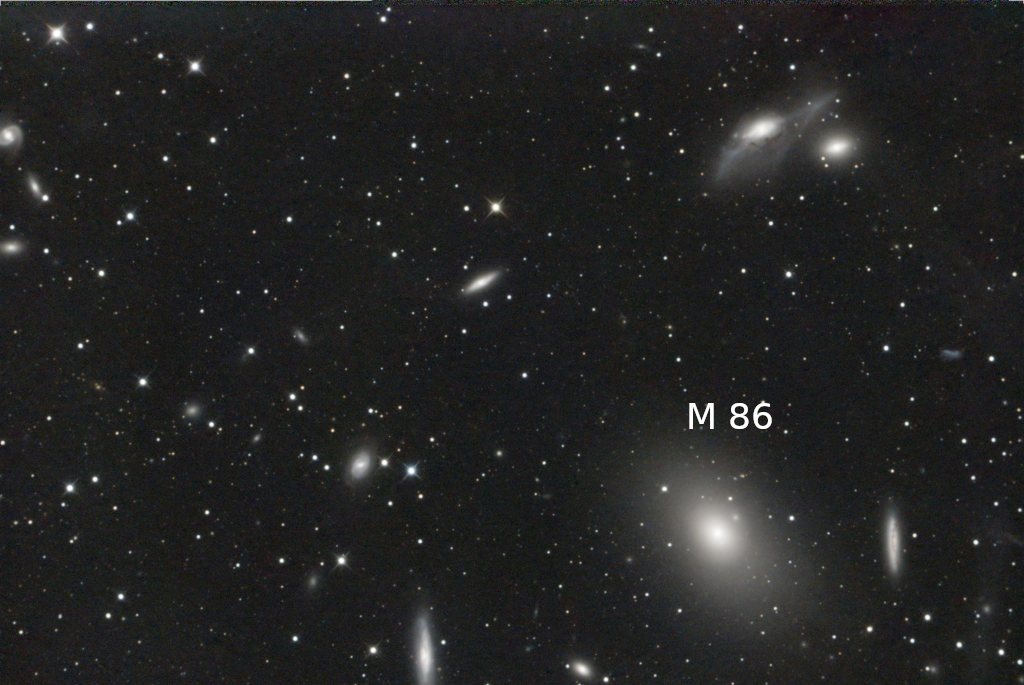
Max and I returned to the Virgo Cluster the next night to continue imaging M84 and M86. More photons are always better. So I entered the exact same coordinates, and off we went. But when we got there something was wrong. You can see that in the image just above. Instead of capturing the same view as before, we were now seeing a different part of the sky. That's not right! M84 isn't even in the view now!
"Max! What happened? I swear I programmed the same coordinates as I did last night. But we're looking at a different sky! It's shifted."
Max came over and sorted through the logs.
"You mixed up the epochs," he said.
"I mixed up the what?"
"Epochs. You mixed up epochs. The standard reference times for Earth's orientation. The same coordinates used in two different epochs are going to point to two different locations."
Our little blue Earth, not perfectly spheroidal, is spinning, not perfectly fixed, but slowly shifting its axis of rotation with respect to the Universe. This is known as "precession." The Conceptual Image Lab at Goddard Space Science Center has a good animation here. You may recognize precession from the behavior of a spinning top that is tilted slightly off vertical and slowly tips around to trace a circle about that vertical axis. The top may take seconds or minutes to complete a cycle of precession. For the Earth, one cycle takes 26,000 years.
This is a real pain for astronomers who keep catalogs of the coordinates of deep space objects. Messier, for example, wrote down the location of M84 when he discovered it in 1871. But if I used his absolute coordinates today I wouldn't even be close to M84.
To ease the confusion, astronomers choose a specific point in time as a standard, as the epoch, for coordinate systems. Today, a commonly used epoch is known as "J2000," which refers to the Orientation of Everything as it was precisely at Noon on January 1, 2000. In practice, when I enter M84 in J2000 coordinates, the astronomy software applies the correct shift to give the present location and, Bingo, we're looking right at M84.
On that second night I entered J2000 coordinates, but I accidentally hit a widget that led the telescope to believe they were today's absolute coordinates, known as the "JNow" epoch. Being a dutiful telescope it went looking in the JNow epoch with my J2000 coordinates. And of course, it ended up looking in the "wrong" place and the view was shifted from the night before. But the shift left some overlap in the two images that Max and I could use to merge the two. A mosaic. You can see that here.
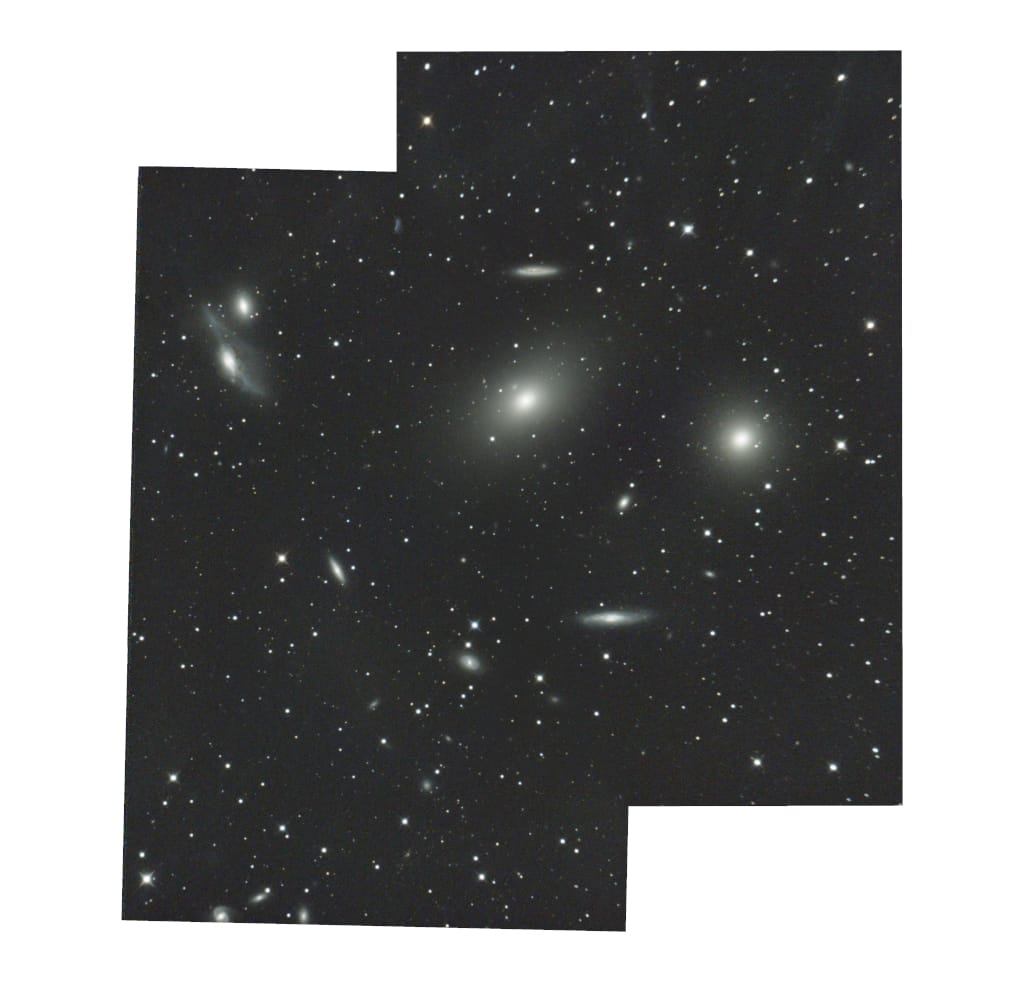
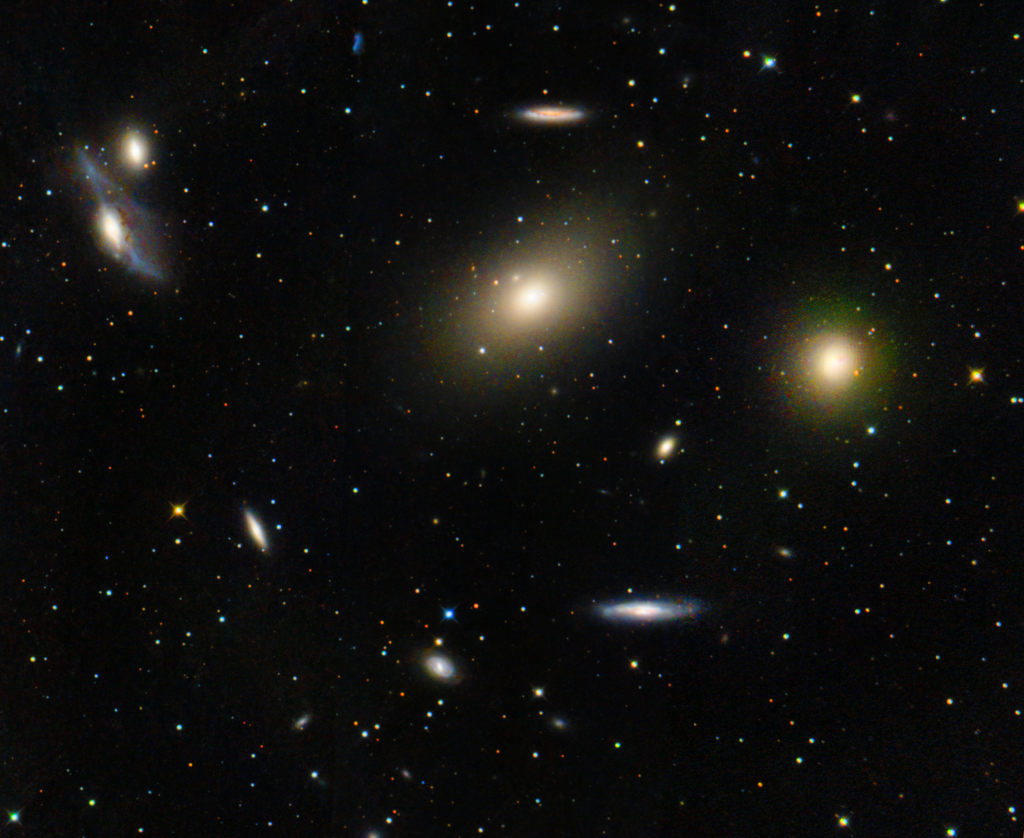
You can see the finished mosaic in the banner image at the top of this post. Now, that wasn't what I intended, but it's pretty cool. That shift in the images? That's the precession of the Earth happening in only about 25 years. Documented. Science! By accident.
Max interrupted, "Cut the power!"
While we were working out our epic clash of epochs, two starship battalions pulled up within sight. One to the East, and one to the North. It was a pretty frightening arrangement; we were caught in a potential cross-fire.
"What's going on, Max?"
"Quiet is good. They're using autonomously controlled AI weapons and we don't want to turn into prompts for their networks. Once they're launched, they call their own shots."
The North battalion fired. Multiple flashes lit up the ships and a barrage of Muskian-Xclass missiles came raging at us.
"It was nice knowing you, Max."
"Don't panic," he said quietly.
Sure enough, the missiles were ignoring us completely and heading, instead, towards their own eastern battalion fleet. The strike was devastating. Dozens of ships exploded, throwing shrapnel in every direction. Secondary blasts continued on from all the ordinance they carried and a blast of smoke and grit filled the quadrant.
"What the ..."
"What a shame," said Max. "They relied on an LLM, a chatbot. And the bot was trained to mix epochs from its training data according to class. It's cross-fire training from "Hannibal Crossing the Delaware" was a joke, completely lost on Secretary Hogspizz, and so it used a joke epoch for the target coordinates. The placement of the East fleet was an event today and so it used the "JNow" epoch. Two different coordinates, from two different epochs, can point to the same place if you twiddle the dials correctly."
"Friendly fire," I said.
"The smell of euphemism," Max replied.
"But what about the North fleet? They're still there and must realize the mistake."
"They fired everything on the attack," said Max. "The regime was never any good at considering alternatives. They'll have to limp back to base."
Secretary Hogspizz was apoplectic.
"You idiot! You bagging collection of rusted resisters!"
"Please! I'm entirely integrated circuits," said DragonBot. "Only the ..."
"Shut up! You idiot claptrap crap of ICs," screamed Hogspizz. "You wiped out my entire battalion fleet, you incompetent droid."
"Yes, I'm sorry," said DragonBot. "You are right, I made a mistake."
"You're damn right you made a mistake. You cost us a fortune. Do you have any idea how much one of those Muskian-Xclass missiles costs?"
"In today's currency, $3 billion, 347 million 721 thous..."
"Aaahhhhgggg! Shut up! You destroyed the whole damn mission with your crap calculations."
"Yes, I'm sorry," repeated DragonBot. "You are right. Would you like me to recalculate the exercise?"
"No, you woke piece of junk! You blew up half my starship fleet. You can go blow yourself up, for all I care."
Max and I were hastily restarting our scope, and packing up the imaging, when the entire North fleet went up in a blast of explosives. It was even more spectacular than the East wing group it had destroyed just 30 min ago.
"Well!" said Max. "I must admit, I didn't see that one coming."
"Come on."
"Let's get out of here."